Fluently Divide Multi-Digit Numbers Using the Standard Algorithm
Show all steps of long division. Check every answer by multiplying: (divisor × quotient) + remainder = dividend.
Recall / Warm-Up
Which multiplication fact would you use to check the division step where 42 is divided by 6?
What is the remainder when 29 is divided by 6?
What is the value of the digit 3 in the number 4,376?
Fluency Practice
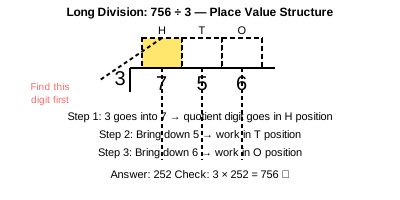
In the problem , which digit of the quotient is found first using the standard algorithm?
Compute using the standard algorithm. Show all four steps (Divide, Multiply, Subtract, Bring down) for each position.
Compute . Write the quotient.
Compute . Write the quotient.
Compute . Check that the remainder is less than 43.
Varied Practice
In , the first digit of the dividend (2) is smaller than the divisor (4). How should the algorithm proceed?
Compute . Write the quotient and remainder.
Compute step by step.
̲ ̲ ̲ ̲ ̲ ̲ ̲ ̲ ̲ ̲ ̲ ̲ ̲ ̲ ̲ ̲ ̲ ̲ ̲ ̲ ̲ ̲ (write this digit above the hundreds).
Bring down 8: new partial dividend = ̲ ̲ ̲ ̲ ̲ ̲ ̲ ̲ ̲ ̲ ̲ ̲ ̲ ̲ ̲ ̲ ̲ ̲ ̲ ̲ ̲ ̲ .
̲ ̲ ̲ ̲ ̲ ̲ ̲ ̲ ̲ ̲ ̲ ̲ ̲ ̲ ̲ ̲ ̲ ̲ ̲ ̲ ̲ ̲ . Bring down 4: new partial dividend = ̲ ̲ ̲ ̲ ̲ ̲ ̲ ̲ ̲ ̲ ̲ ̲ ̲ ̲ ̲ ̲ ̲ ̲ ̲ ̲ ̲ ̲ .
̲ ̲ ̲ ̲ ̲ ̲ ̲ ̲ ̲ ̲ ̲ ̲ ̲ ̲ ̲ ̲ ̲ ̲ ̲ ̲ ̲ ̲ R ̲ ̲ ̲ ̲ ̲ ̲ ̲ ̲ ̲ ̲ ̲ ̲ ̲ ̲ ̲ ̲ ̲ ̲ ̲ ̲ ̲ ̲ .
Quotient: ̲ ̲ ̲ ̲ ̲ ̲ ̲ ̲ ̲ ̲ ̲ ̲ ̲ ̲ ̲ ̲ ̲ ̲ ̲ ̲ ̲ ̲ R ̲ ̲ ̲ ̲ ̲ ̲ ̲ ̲ ̲ ̲ ̲ ̲ ̲ ̲ ̲ ̲ ̲ ̲ ̲ ̲ ̲ ̲ .
Compute . Write the quotient and remainder.
When using a 2-digit divisor and your trial digit gives a remainder that is greater than or equal to the divisor, what should you do?
Word Problems
A school is packing 136 students onto buses. Each bus holds 45 students.
Compute using the standard algorithm. Write the quotient and remainder.
How many buses are needed to transport all 136 students?
A baker has 1,260 cookies to pack into boxes of 36.
How many full boxes can be packed? Are there any cookies left over?
A rope 1,125 cm long is cut into equal pieces of 25 cm each.
How many pieces are cut from the rope?
Mariana shares 25 inches of ribbon equally among 3 friends.
How much ribbon does each friend receive? Choose the correct answer and interpretation.
Error Analysis
Tomas divides . After the first step he has:
- Divided: (writes 2 above)
- Multiplied:
- Subtracted:
- He then writes the next quotient digit: , then
- His final answer:
What step did Tomas skip that led to the wrong answer?
Carmen divides .
Round ; .
She tries 9: — too large.
She tries 8: ; remainder .
She checks: ✓. She writes quotient 8 R 2.
Then she writes: "Since the remainder 2 is very small, I'll just say the answer is 8."
Is Carmen's final answer correct? What should she report?
Challenge / Extension
A library has 2,916 books to be sorted equally onto shelves. Each shelf holds 54 books. How many shelves are needed, and will any books be left on a partial shelf?
If you divide a number by 7 and get a quotient of 34 with remainder 5, what was the original number? Explain how you can find it without doing long division, and verify your answer.