Exercises: Distributions — Center, Spread, and Shape
Use the vocabulary: center, spread, and shape to describe data distributions.
Warm-Up: Review What You Know
These problems review key vocabulary.
A statistical question generates data. What does that data describe?
A dot plot shows scores of 5 students: 70, 75, 75, 80, 80. What is the range of these scores?
Reading Distributions
Use each display to describe the distribution.
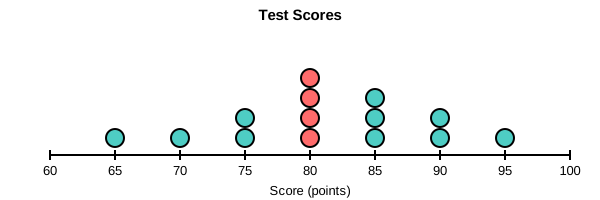
Where do most values in the dot plot cluster?
Use the dot plot of test scores below (values from 65 to 95). Which statement correctly describes the spread?
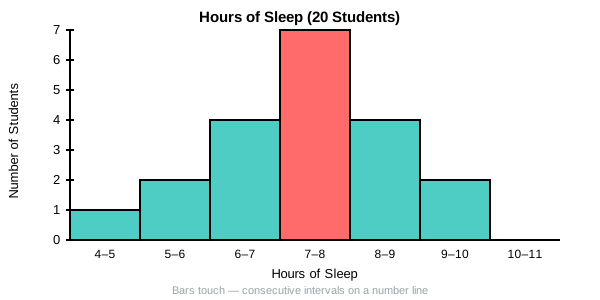
A histogram shows hours of sleep for 20 students. Describe the center, spread, and shape of this distribution in 2–3 sentences.
Mixed Practice
Apply your knowledge of center, spread, and shape in different ways.
A dot plot of plant heights (in cm) shows values: 8, 9, 9, 10, 10, 10, 11, 11, 12. Which statement correctly identifies the center?
A dot plot shows commute times (in minutes) for workers: 10, 15, 15, 20, 20, 20, 25, 30, 45. The center is approximately ̲ ̲ ̲ ̲ ̲ ̲ ̲ ̲ ̲ ̲ ̲ ̲ ̲ ̲ ̲ ̲ ̲ ̲ ̲ ̲ ̲ ̲ minutes. The spread goes from ̲ ̲ ̲ ̲ ̲ ̲ ̲ ̲ ̲ ̲ ̲ ̲ ̲ ̲ ̲ ̲ ̲ ̲ ̲ ̲ ̲ ̲ to ̲ ̲ ̲ ̲ ̲ ̲ ̲ ̲ ̲ ̲ ̲ ̲ ̲ ̲ ̲ ̲ ̲ ̲ ̲ ̲ ̲ ̲ minutes. The shape is ̲ ̲ ̲ ̲ ̲ ̲ ̲ ̲ ̲ ̲ ̲ ̲ ̲ ̲ ̲ ̲ ̲ ̲ ̲ ̲ ̲ ̲ .
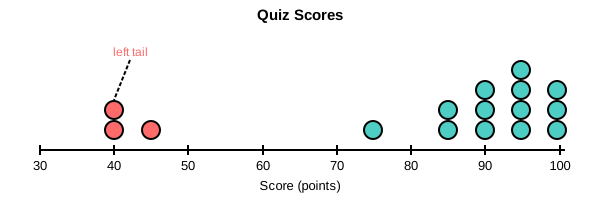
A dot plot of students' scores on a quiz shows most scores between 85 and 100, with a few scores near 40. Which shape best describes this distribution?
Two classes took the same test. Class A's scores cluster tightly around 75, with values from 70 to 80. Class B's scores also cluster around 75, but range from 40 to 100. Class A has ̲ ̲ ̲ ̲ ̲ ̲ ̲ ̲ ̲ ̲ ̲ ̲ ̲ ̲ ̲ ̲ ̲ ̲ ̲ ̲ ̲ ̲ spread than Class B. The center of both classes is approximately ̲ ̲ ̲ ̲ ̲ ̲ ̲ ̲ ̲ ̲ ̲ ̲ ̲ ̲ ̲ ̲ ̲ ̲ ̲ ̲ ̲ ̲ .
A histogram shows household incomes in a neighborhood. Most households earn between $40,000 and $80,000, but a few earn over $300,000. What does this shape tell you about the real-world context?
Word Problems
Use distributions to answer questions about real-world contexts.
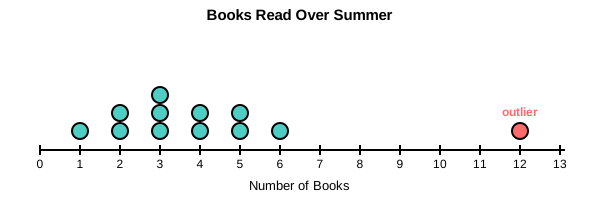
A teacher recorded how many books 12 students read over the summer. The dot plot shows: 1, 2, 2, 3, 3, 3, 4, 4, 5, 5, 6, 12.
What is the approximate center of this distribution?
Describe the shape of this distribution and explain what it tells you about how much students read.
Two classes scored a mean of 75 on a test. Class A's scores range from 70 to 80; Class B's scores range from 50 to 100, and both distributions are roughly symmetric.
What does the difference in spread tell you about the two classes?
Find the Mistake
Each problem shows a student's reasoning that contains an error. Find and explain the mistake.
A dot plot shows test scores: 70, 72, 75, 75, 80, 80, 80, 85, 90, 100.
Sam said: "The center of this distribution is 100 — it's the highest point on the dot plot."
What is wrong with Sam's reasoning?
A dot plot shows student heights (in cm): 140, 145, 148, 150, 150, 152, 155, 158, 160, 165.
Alex described the distribution: "The spread is from 140 cm to 165 cm."
What is missing from Alex's description of spread?
Challenge Problems
These problems require deeper reasoning about distributions.
Two histograms show the daily high temperatures (°F) for two different cities over a year. City A has a roughly symmetric distribution centered around 72°F with values from 55°F to 89°F. City B has a roughly symmetric distribution centered around 72°F with values from 20°F to 105°F. Both cities have the same average temperature. What does the difference in spread tell you about what it is like to live in each city?
A distribution is described as 'bimodal.' What does this mean, and what real-world situation might produce a bimodal distribution of heights in a school?