Exercises: Dot Plots, Histograms, and Box Plots
Show your work for each construction. Label all axes with variable names and units.
Warm-Up: Review What You Know
These problems review skills you need for constructing displays.
A dot plot places each data value as a dot on a number line. If four students scored 85 on a test, how many dots appear at 85 on the dot plot?
A histogram shows data grouped into intervals. The interval 20–30 has a bar of height 5. What does this mean?
Sort this data set and find the median (middle value): {7, 3, 9, 5, 11}.
Fluency Practice
Construct or analyze each type of data display.
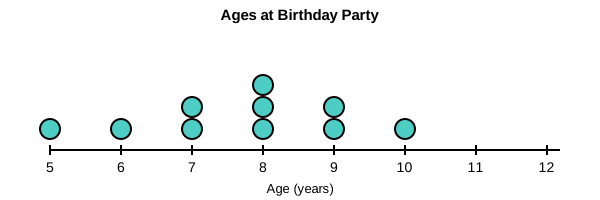
A dot plot shows ages of 10 children at a birthday party. Use the dot plot to answer: What is the most common age (the value with the most dots)?
Using the dot plot of ages above (values: 5, 6, 7, 7, 8, 8, 8, 9, 9, 10), what is the range?
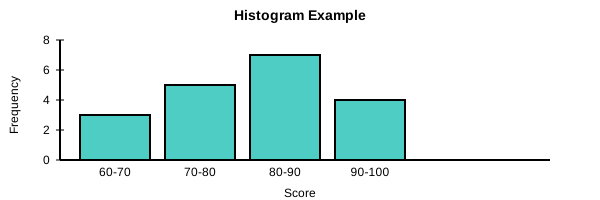
A student drew a histogram and left spaces between the bars. What error did the student make?
A histogram shows quiz scores in intervals of width 10: [60,70) has 2 students, [70,80) has 6 students, [80,90) has 8 students, [90,100] has 4 students. How many students took the quiz in total?
Find the median of this sorted data set of 11 values: {42, 45, 50, 55, 60, 65, 68, 72, 75, 80, 90}.
Sorted data: {42, 45, 50, 55, 60, 65, 68, 72, 75, 80, 90}. The median is 65. The lower half (excluding median) is {42, 45, 50, 55, 60}. Q1 = ̲ ̲ ̲ ̲ ̲ ̲ ̲ ̲ ̲ ̲ ̲ ̲ ̲ ̲ ̲ ̲ ̲ ̲ ̲ ̲ ̲ ̲ . The upper half (excluding median) is {68, 72, 75, 80, 90}. Q3 = ̲ ̲ ̲ ̲ ̲ ̲ ̲ ̲ ̲ ̲ ̲ ̲ ̲ ̲ ̲ ̲ ̲ ̲ ̲ ̲ ̲ ̲ . IQR = Q3 − Q1 = ̲ ̲ ̲ ̲ ̲ ̲ ̲ ̲ ̲ ̲ ̲ ̲ ̲ ̲ ̲ ̲ ̲ ̲ ̲ ̲ ̲ ̲ .
For the data set {42, 45, 50, 55, 60, 65, 68, 72, 75, 80, 90}, the five-number summary is: Min = 42, Q1 = 50, Median = 65, Q3 = 75, Max = 90. What is the range (Max − Min)?
Mixed Practice
Apply your knowledge of all three display types.
A dot plot shows the number of library books checked out by 8 students: 1, 2, 2, 3, 4, 4, 5, 10. Which statement is most accurate about this distribution?
A histogram of plant heights (cm) uses intervals [0,10), [10,20), [20,30), [30,40). The bar for [20,30) is the tallest. What does this tell you about the center of the distribution?
Sorted data (9 values): {10, 20, 30, 35, 40, 45, 50, 60, 80}. For the box plot of this data: the box spans from ̲ ̲ ̲ ̲ ̲ ̲ ̲ ̲ ̲ ̲ ̲ ̲ ̲ ̲ ̲ ̲ ̲ ̲ ̲ ̲ ̲ ̲ to ̲ ̲ ̲ ̲ ̲ ̲ ̲ ̲ ̲ ̲ ̲ ̲ ̲ ̲ ̲ ̲ ̲ ̲ ̲ ̲ ̲ ̲ ; the IQR is ̲ ̲ ̲ ̲ ̲ ̲ ̲ ̲ ̲ ̲ ̲ ̲ ̲ ̲ ̲ ̲ ̲ ̲ ̲ ̲ ̲ ̲ ; the median line is at ̲ ̲ ̲ ̲ ̲ ̲ ̲ ̲ ̲ ̲ ̲ ̲ ̲ ̲ ̲ ̲ ̲ ̲ ̲ ̲ ̲ ̲ .
A box plot shows test scores with Min = 50, Q1 = 65, Median = 73, Q3 = 81, Max = 96. The left whisker (from Min to Q1) is 15 units long. The right whisker (from Q3 to Max) is 15 units long. What does this tell you about the shape?
A box plot for a data set has Q1 = 30, Median = 50, Q3 = 70. The box section from Q1 to Median looks much wider than the section from Median to Q3. A student says: 'The lower half of the box has more data points than the upper half.' Is the student correct?
Word Problems
Use data displays to answer real-world questions.
A science teacher recorded the number of days it rained each month for 12 months: 3, 5, 7, 7, 8, 10, 10, 11, 12, 14, 15, 18.
How many months had between 7 and 12 rainy days (inclusive)?
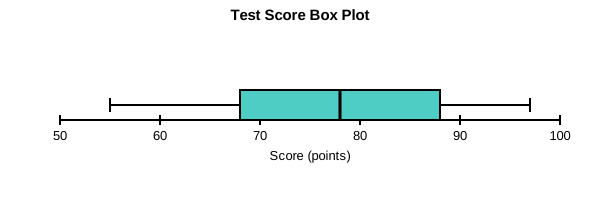
Test scores for 11 students (sorted): 55, 62, 68, 71, 74, 78, 82, 85, 88, 91, 97.
For the sorted data {55, 62, 68, 71, 74, 78, 82, 85, 88, 91, 97}, find the five-number summary. Min = ̲ ̲ ̲ ̲ ̲ ̲ ̲ ̲ ̲ ̲ ̲ ̲ ̲ ̲ ̲ ̲ ̲ ̲ ̲ ̲ ̲ ̲ , Q1 = ̲ ̲ ̲ ̲ ̲ ̲ ̲ ̲ ̲ ̲ ̲ ̲ ̲ ̲ ̲ ̲ ̲ ̲ ̲ ̲ ̲ ̲ , Median = ̲ ̲ ̲ ̲ ̲ ̲ ̲ ̲ ̲ ̲ ̲ ̲ ̲ ̲ ̲ ̲ ̲ ̲ ̲ ̲ ̲ ̲ , Q3 = ̲ ̲ ̲ ̲ ̲ ̲ ̲ ̲ ̲ ̲ ̲ ̲ ̲ ̲ ̲ ̲ ̲ ̲ ̲ ̲ ̲ ̲ , Max = ̲ ̲ ̲ ̲ ̲ ̲ ̲ ̲ ̲ ̲ ̲ ̲ ̲ ̲ ̲ ̲ ̲ ̲ ̲ ̲ ̲ ̲ .
Using the box plot shown, which statement best describes the distribution?
Find the Mistake
Each problem shows a student's work with an error. Find and explain the mistake.
A student made a histogram for data on student commute times (minutes). The bars are for intervals [0,10), [10,20), [20,30), [30,40). The student left a gap between each bar, claiming: "I leave gaps so you can see where the intervals end."
What is wrong with the student's approach?
Sorted data: {10, 14, 18, 22, 26, 30, 34, 38, 42, 46, 50}
Student work:
Median = 30 (6th value, middle of 11).
Q1 = median of {10, 14, 18, 22, 26, 30} = average of 3rd and 4th values of this group = (18+22)/2 = 20.
Q3 = median of {30, 34, 38, 42, 46, 50} = average of 3rd and 4th values = (38+42)/2 = 40.
What mistake did the student make when finding Q1 and Q3?
Challenge Problems
These problems require multi-step reasoning.
A box plot shows: Min = 20, Q1 = 35, Median = 50, Q3 = 65, Max = 80. If the data set has 20 values total, how many values fall between Q1 (35) and Q3 (65)?
A data set has 15 values. You want to choose a display. The data ranges from 1 to 30. Explain when you would choose a dot plot vs. a histogram for this data, and what information would be lost with each choice.