Drawing Geometric Shapes: Constructing Triangles and Exploring Uniqueness
Work through each section. For multiple-choice questions, select the best answer. For short-response questions, write complete sentences.
Recall / Warm-Up
Which type of angle has a measure of 115°?
In triangle XYZ, angle X measures 72° and angle Y measures 41°. What is the measure of angle Z?
In triangle PQR, which angle is the included angle between sides PQ and PR?
Fluency Practice
Which set of side lengths can form a valid triangle?
A student constructs a triangle with sides 5 cm, 8 cm, and 6 cm using SSS. How many distinct triangles can be made with these three side lengths?
Which condition always produces exactly one distinct triangle (up to congruence)?
In triangle DEF, angle D measures 55° and angle E measures 48°. What is the measure of angle F, in degrees?
You draw a triangle with angles 40°, 60°, and 80°. How many different triangles exist with these same three angle measures?
Varied Practice
Which set of side lengths CANNOT form a triangle?
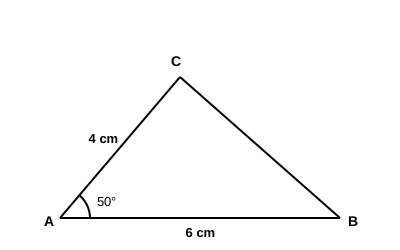
The figure shows triangle ABC with AB = 6 cm, AC = 4 cm, and angle A = 50°. Yuki says this is an SAS construction. Is Yuki correct, and how many distinct triangles have these measurements?
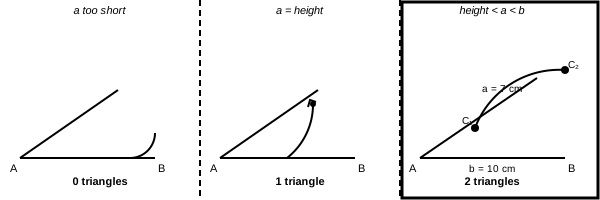
The figure shows an SSA setup: angle A = 35°, side b = 10 cm (from A to B), and side a = 7 cm (the arc radius from B). How many distinct triangles can be formed?
Two students both draw a triangle using angles 45°, 65°, and 70°. Student 1 starts with a 4 cm base; Student 2 starts with an 8 cm base. Explain in one sentence why these two triangles are NOT identical, even though both satisfy the given angle conditions.
Word Problems
Priya applies the triangle inequality before purchasing materials.
Priya wants to enclose a triangular garden using fence sections of lengths 5 m, 8 m, and 14 m. Without any tools, can she determine if the triangular garden is possible?
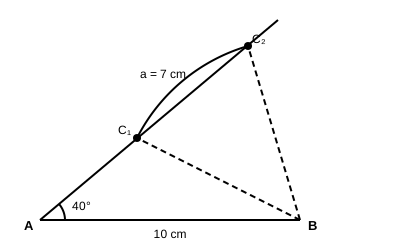
Kemal is designing a triangular support for a tent. Angle A (at one corner) measures 40°. The side from A to B is 10 cm, and the support pole connecting B to the far ray of angle A is 7 cm long. The diagram shows the arc of possible positions for the pole's far endpoint.
How many distinct triangles can Kemal form using these measurements?
One triangle has an acute angle at the top (at C₁). In that triangle, angle A = 40° and the top angle at C₁ measures 55°. What is the measure of angle B in that triangle?
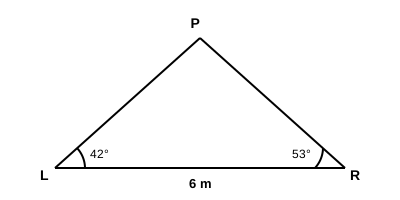
Two builders fix a roof truss base at 6 m, then measure the angle at the left end as 42° and the angle at the right end as 53°. The figure shows the setup. How many distinct trusses can they build with these measurements?
A tile designer makes triangular ceramic tiles with angles 50°, 60°, and 70°. She says all tiles with these three angles will be identical. Is she correct?
Error Analysis
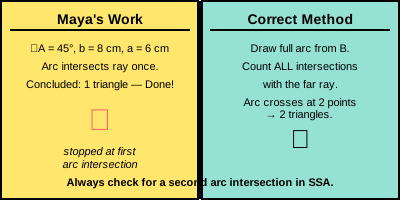
Maya is given: angle A = 45°, side b = 8 cm (from A to B), and side a = 6 cm (the swinging side from B).
Maya's work:
- She draws angle A = 45° and marks B on the base ray at 8 cm from A.
- She sets her compass to 6 cm at B and draws an arc.
- The arc intersects the far ray of angle A at one point. She labels it C and draws triangle ABC.
- Maya writes: "I found one valid triangle. There is exactly one triangle with these measurements. Done."
Maya's conclusion is wrong. What error did she make?
What error did Maya make in her SSA triangle construction?
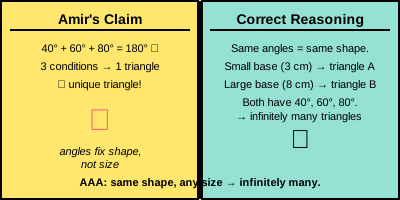
Amir draws a triangle with angles 40°, 60°, and 80° and writes:
"I verified that 40° + 60° + 80° = 180°, so the triangle is valid. I gave three conditions, and my triangle is the only one satisfying all three. Therefore, AAA gives a unique triangle."
What is wrong with Amir's reasoning?
What error did Amir make in his reasoning about AAA triangle uniqueness?
Challenge
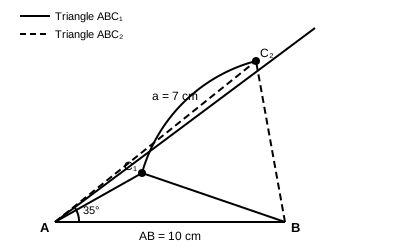
The figure shows two triangles, ABC₁ and ABC₂, both satisfying: angle A = 35°, AB = 10 cm, and BC = 7 cm. Which statement is TRUE about these two triangles?
Explain in 2–3 sentences why 'two sides and a non-included angle' (SSA) cannot serve as a triangle congruence condition. Include a specific numerical example to support your explanation.