Cross-Sections of Three-Dimensional Figures
For each problem, read the description of the solid and the cut carefully before naming the cross-section. Drawing a quick sketch may help.
Recall / Warm-Up
Which polygon has exactly four sides and four right angles?
Which 3D figure has a rectangular base and triangular faces that all meet at a single point above the base?
Which polygon has exactly two pairs of parallel sides but does NOT necessarily have four right angles?
Fluency Practice
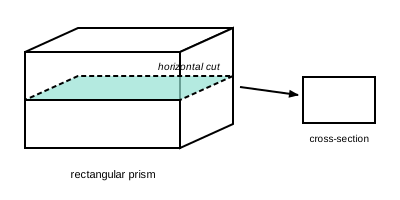
A right rectangular prism is cut with a horizontal plane parallel to its base. What shape is the cross-section?
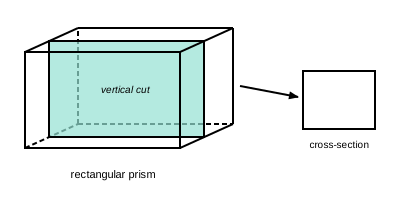
A right rectangular prism is cut with a vertical plane perpendicular to the base and parallel to the front face. What shape is the cross-section?
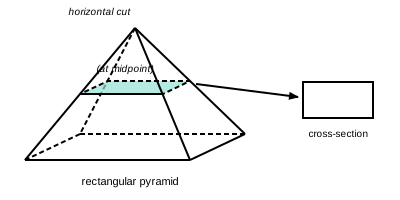
A right rectangular pyramid is cut with a horizontal plane parallel to the base, halfway between the base and the apex. What shape is the cross-section?
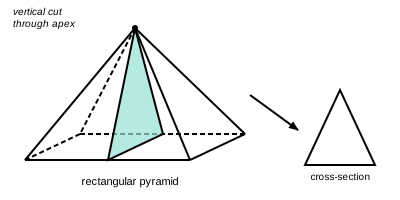
A right rectangular pyramid is cut with a vertical plane that passes exactly through the apex and through the midpoints of two opposite base edges. What shape is the cross-section?
A rectangular prism is sliced with a diagonal cut that is not parallel to any of its faces. The cross-section is a ̲ ̲ ̲ ̲ ̲ ̲ ̲ ̲ ̲ ̲ ̲ ̲ ̲ ̲ ̲ ̲ ̲ ̲ ̲ ̲ ̲ ̲ .
Varied Practice
A rectangular prism is sliced with a horizontal plane parallel to its base. Which statement about the cross-section is always true?
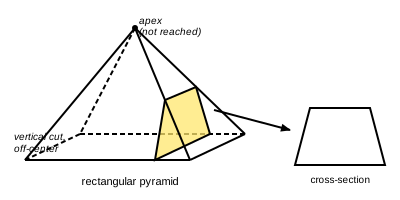
A right rectangular pyramid is cut with a vertical plane that is parallel to one pair of base edges but does NOT pass through the apex. What shape is the cross-section?
Which cutting direction applied to a right rectangular prism would produce a cross-section that is a parallelogram but NOT a rectangle?
A rectangular prism is cut in two different ways: first with a horizontal plane parallel to the base, and then with a diagonal plane not parallel to any face. Describe each cross-section and explain what geometric property of the cutting plane causes the shapes to be different.
Word Problems
A block of tofu is shaped like a right rectangular prism. A chef makes a straight horizontal cut through the middle to create two equal slabs. What shape is the exposed cut surface?
A chocolate bar is shaped like a right rectangular prism. Leila cuts it with a diagonal slice that is not parallel to any of the bar's faces. What shape is the cross-section, and how do you know?
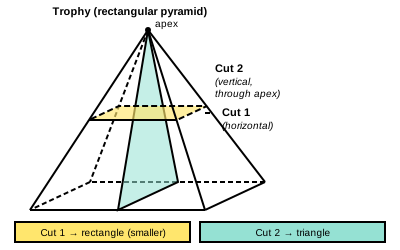
A trophy is shaped like a right rectangular pyramid. The trophy is 12 cm tall with a rectangular base. Two different cuts are made to study the shape.
When the trophy is cut horizontally at its midpoint (halfway between base and apex), the cross-section is a ̲ ̲ ̲ ̲ ̲ ̲ ̲ ̲ ̲ ̲ ̲ ̲ ̲ ̲ ̲ ̲ ̲ ̲ ̲ ̲ ̲ ̲ .
When the trophy is cut vertically through the apex (from apex straight down through the center of the base), the cross-section is a ̲ ̲ ̲ ̲ ̲ ̲ ̲ ̲ ̲ ̲ ̲ ̲ ̲ ̲ ̲ ̲ ̲ ̲ ̲ ̲ ̲ ̲ .
A display piece is shaped like a right rectangular pyramid. It is cut with a vertical plane that does NOT pass through the apex — the plane is parallel to one pair of triangular faces but cuts across the other two triangular faces only. The cross-section is a trapezoid. Explain why a vertical cut that DOES pass through the apex produces a triangle instead of a trapezoid.
Error Analysis
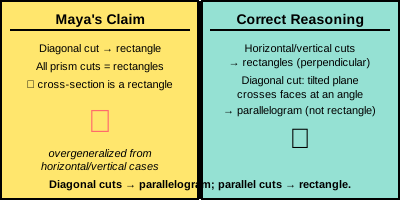
Maya sliced a rectangular prism with a diagonal cut that was not parallel to any face.
She wrote: "The cross-section is a rectangle because all cuts of a rectangular prism produce rectangles."
Read Maya's work below. Identify her error and choose the correct explanation.
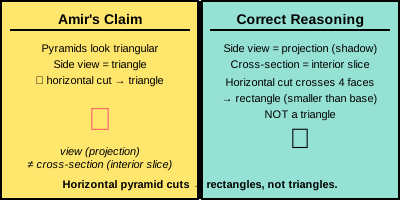
Amir sliced a right rectangular pyramid with a horizontal plane parallel to the base, cutting through the middle.
He wrote: "The cross-section is a triangle because pyramids are triangular — you can see the triangle shape when you look at a pyramid from the side."
Read Amir's work below. Identify his error and choose the correct explanation.
Challenge
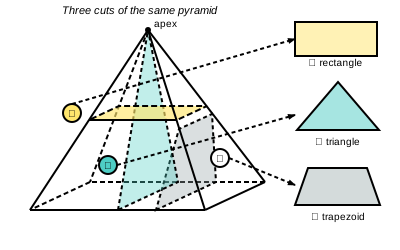
Three cross-sections are described: (1) a rectangle the same size as the base, (2) a triangle with its apex at the top, and (3) a trapezoid. Each cross-section came from a different cut of the same solid. Which 3D solid must this be, and what cutting direction produced each cross-section? Explain your reasoning.
Compare the cross-sections of a rectangular prism and a rectangular pyramid. In what ways are they similar when cut horizontally, and in what ways do their cross-sections differ as you move the horizontal cut from the base toward the top? Explain using geometric properties.