Angle Relationships and Equations
For each problem, identify the angle relationship, write an equation, solve, and verify your answer.
Recall / Warm-Up
Two angles are supplementary. One angle measures 47°. What is the measure of the other angle?
Solve for x: 3x + 12 = 90. What is the value of x?
Two angles are complementary. One angle measures 62°. What is the measure of the other angle?
Fluency Practice
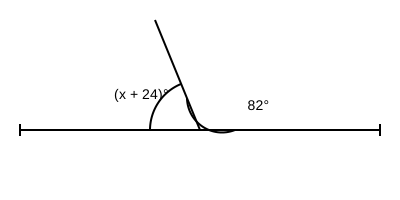
Two angles form a straight line. One angle measures and the other measures 82°. Find the value of .
Two angles are complementary. One angle measures and the other measures 56°. Find the value of .
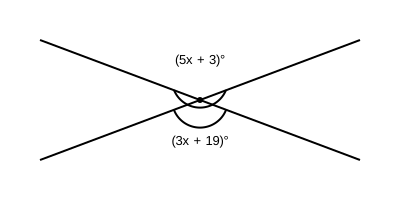
Two intersecting lines form vertical angles. One angle measures and its vertical angle measures . Find the measure of the angle.
Find the measure of the supplement of a 73° angle.
Two straight lines cross at a point. One of the four angles measures 68°. What are the measures of the other three angles, listed in clockwise order starting from the 68° angle?
Varied Practice
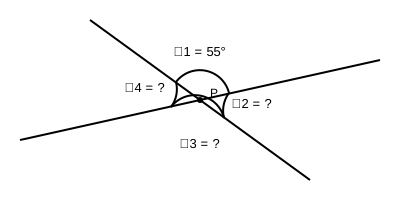
Two lines intersect at point P. The four angles are labeled ∠1, ∠2, ∠3, and ∠4 going clockwise, starting from the top-left. If ∠1 measures 55°, which other angle also measures 55°?
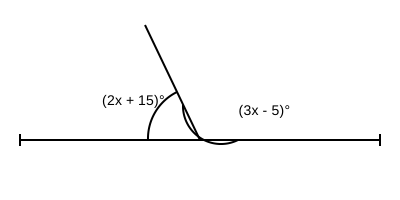
Two supplementary angles measure and . The value of is ̲ ̲ ̲ ̲ ̲ ̲ ̲ ̲ ̲ ̲ ̲ ̲ ̲ ̲ ̲ ̲ ̲ ̲ ̲ ̲ ̲ ̲ . The larger angle measures ̲ ̲ ̲ ̲ ̲ ̲ ̲ ̲ ̲ ̲ ̲ ̲ ̲ ̲ ̲ ̲ ̲ ̲ ̲ ̲ ̲ ̲ °.
Angle P and angle Q are complementary. Angle Q and angle R are supplementary. If angle P measures 32°, find the measure of angle R. Show each step and state which angle relationship you used.
Two adjacent angles on a straight line measure and . Find the value of .
Word Problems
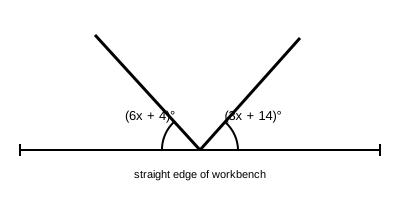
Marta is building a wooden frame. Two planks meet at a point on a straight edge, forming two supplementary angles. One plank creates an angle of with the edge. The other creates an angle of .
How many degrees does the smaller angle measure?
Two streets intersect. One angle at the intersection measures . The angle directly across from it (a vertical angle) measures .
What is the degree measure of this vertical angle pair?
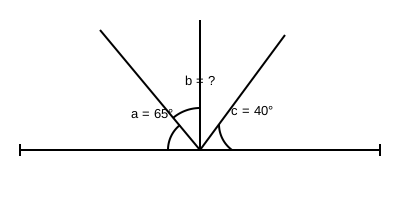
A horizontal line has three rays extending upward from a single point on the line, creating three angles above it: angle a on the left (measuring 65°), angle b in the middle (unknown), and angle c on the right (measuring 40°).
What is the measure of angle b?
Are angles a and c supplementary? Explain how you know.
A parking lot has two rows of spaces that meet at an intersection. The angle between Row 1 and the main drive measures . The angle between Row 2 and the main drive, directly across the intersection, measures . The two row angles are vertical angles.
Find the value of x, then find the measure of the angle each row makes with the main drive. Show all work and verify your answer.
Error Analysis
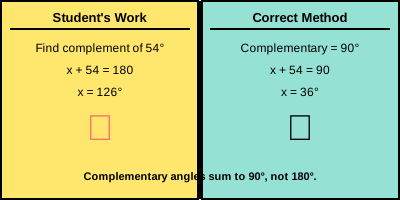
A student solved this problem: "Find the complement of 54°."
The student's work:
- x + 54 = 180
- x = 126°
What error did the student make?
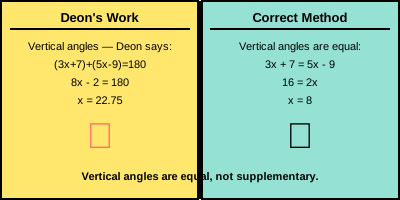
Deon solved this problem: 'Two lines intersect. One angle measures and the vertical angle measures . Find x.'
Deon's work:
What error did Deon make?
Challenge / Extension
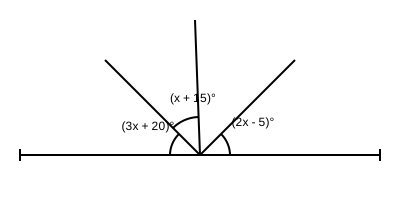
Three rays extend from a single point on a straight line, creating three angles above the line. The angles measure , , and from left to right. What is the measure of the largest angle?
Two lines intersect. One angle measures and the adjacent angle measures . (a) Write an equation and solve for x. (b) Find all four angle measures at the intersection. (c) Verify your answer by confirming that each adjacent pair sums to 180° and each vertical pair is equal.