Area, Volume, and Surface Area of 2D and 3D Figures
For each problem, show your work and include appropriate units in your answer.
Recall / Warm-Up
A trapezoid has parallel sides of 5 cm and 9 cm, and a height of 4 cm. What is its area?
A rectangular prism has a length of 8 m, width of 5 m, and height of 3 m. What is its volume in cubic meters?
A circle has a radius of 7 cm. Using π ≈ 3.14, what is its area?
Fluency Practice
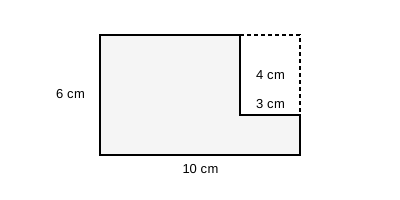
An L-shaped figure is formed by starting with a 10 cm × 6 cm rectangle and removing a 3 cm × 4 cm rectangle from the top-right corner. What is the area of the L-shaped figure in square centimeters?
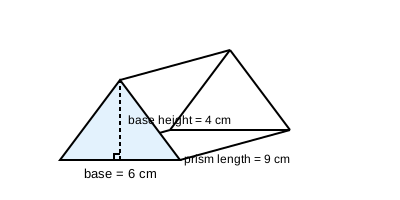
A triangular prism has a triangular base with a base of 6 cm and a height of 4 cm. The prism is 9 cm long. What is the volume of the prism in cubic centimeters?
A rectangular prism has dimensions 8 cm × 5 cm × 3 cm. What is its total surface area in square centimeters?
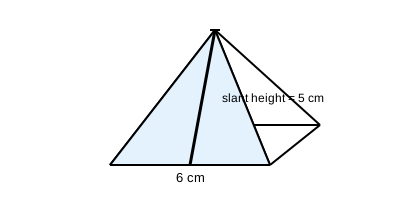
A square pyramid has a base of 6 cm × 6 cm and a slant height of 5 cm. What is the total surface area in square centimeters?
A trapezoidal prism has a trapezoidal base with parallel sides of 5 m and 9 m, and a base height of 4 m. The prism is 7 m long. What is the volume in cubic meters?
Varied Practice
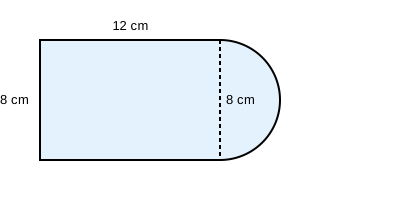
A composite figure consists of a 12 cm × 8 cm rectangle with a semicircle of diameter 8 cm attached to one end. What is the total area of the figure? Use π ≈ 3.14.
A triangular prism has an equilateral triangular base with side length 6 cm and area approximately 15.6 cm². The prism is 10 cm long. What is the total surface area of the prism?
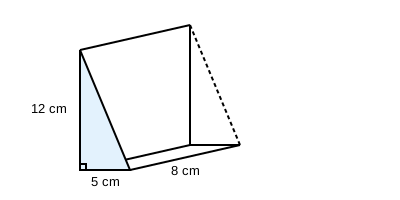
A triangular prism has a right triangle base with legs of 5 cm and 12 cm. The prism is 8 cm long. The base area is ̲ ̲ ̲ ̲ ̲ ̲ ̲ ̲ ̲ ̲ ̲ ̲ ̲ ̲ ̲ ̲ ̲ ̲ ̲ ̲ ̲ ̲ cm² and the volume is ̲ ̲ ̲ ̲ ̲ ̲ ̲ ̲ ̲ ̲ ̲ ̲ ̲ ̲ ̲ ̲ ̲ ̲ ̲ ̲ ̲ ̲ cm³.
A homeowner needs to complete three tasks: (I) cover a floor with tile; (II) fill an aquarium with water; (III) wrap a gift box with paper. Which set of measures correctly matches each task?
Word Problems
A community park has an L-shaped layout. The outer dimensions are 20 m × 15 m. A rectangular section 6 m × 8 m is removed from one corner for a playground structure.
What is the area of the park region in square meters?
A storage container is shaped like a triangular prism. Its right triangle base has legs of 3 ft and 4 ft. The container is 10 ft long.
How many cubic feet of storage space does the container hold?
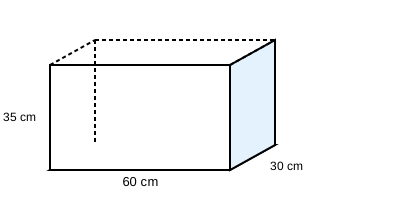
A fish tank is shaped like a rectangular prism with a length of 60 cm, a width of 30 cm, and a height of 35 cm.
How many liters of water can the tank hold when filled to the top? (1 liter = 1,000 cm³)
The tank has no lid. How many square centimeters of glass are needed to make the 5 faces of the tank?
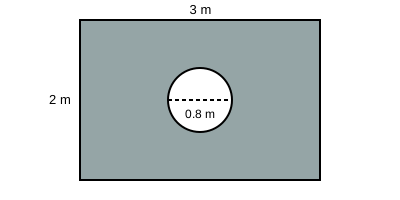
A rectangular wall panel is 3 m wide and 2 m tall. A circular window with a diameter of 0.8 m is cut from the center of the panel.
What is the painted area of the panel in square meters? Use π ≈ 3.14. Round your answer to the nearest hundredth.
Error Analysis
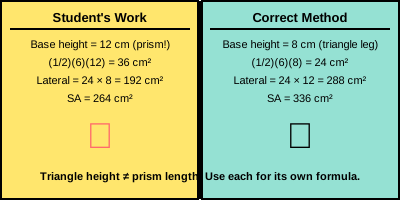
A student computes the surface area of a triangular prism. The right triangle base has legs of 6 cm and 8 cm (hypotenuse 10 cm). The prism is 12 cm long. The student writes:
"Base height = 12 cm (prism length). Base area = (1/2)(6)(12) = 36 cm². Perimeter = 6 + 8 + 10 = 24 cm. Lateral area = 24 × 8 = 192 cm². SA = 2(36) + 192 = 264 cm²."
What error did the student make?
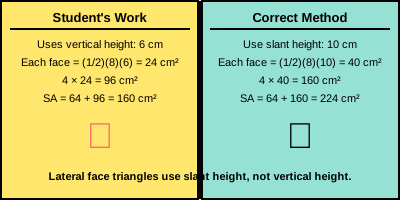
A student computes the surface area of a square pyramid. The base is 8 cm × 8 cm, the slant height is 10 cm, and the vertical height is 6 cm. The student writes:
"Base area = 8² = 64 cm². Each triangular face = (1/2)(8)(6) = 24 cm². SA = 64 + 4(24) = 64 + 96 = 160 cm²."
What error did the student make?
Challenge / Extension
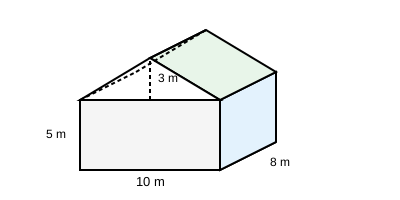
A building model is made of two parts stacked together: a rectangular prism base (length 10 m, width 8 m, height 5 m) with a triangular prism roof on top. The triangular face of the roof has a base of 10 m and a height of 3 m, and the roof extends the full 8 m width of the building.
What is the total volume of the building model in cubic meters?
Priya wants to build a closed box shaped like a triangular prism. The right triangle base has legs of 5 cm and 12 cm (hypotenuse 13 cm). The box is 20 cm long. She has 900 cm² of cardboard.
Does Priya have enough cardboard to make the box? Show your surface area calculation and explain your reasoning.