Multiplying and Dividing Rational Numbers
Recall / Warm-Up
What is the value of ?
The additive inverse of a number satisfies . What is the additive inverse of ?
What is the reciprocal (multiplicative inverse) of ?
Fluency Practice
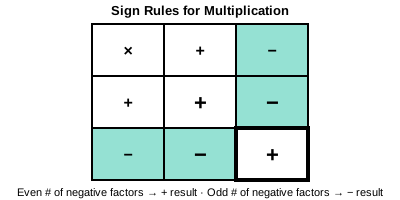
Compute .
Compute .
Compute . Express your answer as a fraction in simplest form.
Compute . Express your answer as a fraction in simplest form.
Which expression is NOT equivalent to ?
Varied Practice
What is the value of ?
Use long division to convert to a decimal. The digits that repeat form a block; write that repeating block: ̲ ̲ ̲ ̲ ̲ ̲ ̲ ̲ ̲ ̲ ̲ ̲ ̲ ̲ ̲ ̲ ̲ ̲ ̲ ̲ ̲ ̲ . This decimal ̲ ̲ ̲ ̲ ̲ ̲ ̲ ̲ ̲ ̲ ̲ ̲ ̲ ̲ ̲ ̲ ̲ ̲ ̲ ̲ ̲ ̲ (write 'terminates' or 'repeats').
The temperature drops 4.5 degrees per hour. After 3 hours, what is the total temperature change, and what does the sign of the result mean?
Compute . Look for a way to simplify before multiplying.
Word Problems
A stock loses $6 in value each day during a 5-day trading slump.
What is the total change in the stock's value over the 5 days? Express your answer as an integer.
A submarine descends at a steady rate of meter per second.
What is the submarine's position, in meters, relative to its starting point after 8 seconds?
During a cold snap, the temperature drops 2.5 degrees Celsius per hour.
What is the total temperature change after 4 hours? Express as a decimal.
A total temperature drop of 10 degrees Celsius occurs at a slower rate of degrees per hour. How many hours does this take? Express as a decimal.
Zara measures a soil temperature change of degree Celsius during an experiment.
Convert this measurement to a decimal. Express your answer to the nearest thousandth.
Error Analysis
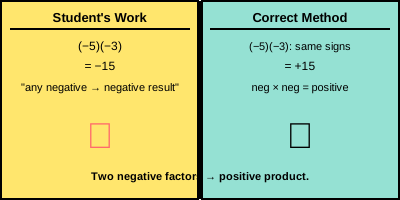
Alex computed :
Step 1:
Step 2:
Alex said: "Any multiplication involving a negative sign gives a negative result."
What error did Alex make?
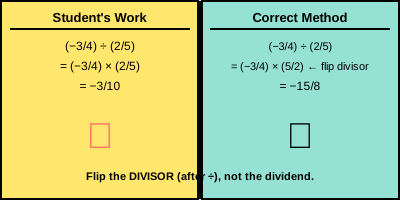
Bella computed :
Step 1: Change ÷ to ×
Step 2:
Step 3:
What error did Bella make?
Challenge
Compute . Express your answer as a fraction or integer.
Use the distributive property to explain why . Start with the fact that . Show each step of your reasoning and explain what you conclude at each step.