Does Equal Up and Down Cancel Out?
An item costs $200.
- After a 20% increase:
- After a 20% decrease:
Final price: $192 — not $200!
The second percent applies to a different base than the first.
The Percent Change Formula Explained
- Positive result → percent increase
- Negative result → percent decrease
- The denominator is always the original (before) value
"Percent of WHAT?" → percent of the ORIGINAL
Worked Example: Computing Percent Increase
A store's weekly sales rose from $4,000 to $4,600. What is the percent increase?
Base = $4,000 (the original sales) — not $4,600
Worked Example: Computing Percent Decrease
A $250 coat is marked down to $190. What is the percent decrease?
The sale price is 24% less than the original — base is $250
Check: Percent Increase From 80 to 92
A student's score improved from 80 to 92. What is the percent increase?
What is the correct base for this calculation?
Compute the percent increase.
Answer: The Score Increased by Fifteen Percent
Using 92 as the base gives
— incorrect
Worked Example: Finding the New Value
A town's population of 3,200 increases by 12.5%. What is the new population?
Chain of Changes: The Trap
$200 item: +10% then −10%
The Percent Error Formula Explained
- Numerator: absolute value of the difference (always positive)
- Denominator: the actual (true) value — not the measured value
- Use when comparing a measurement or estimate to a known true value
Worked Example: Percent Error (Length)
A student measures a room as 28 ft. The actual length is 30 ft.
Denominator = 30 (actual) — if you use 28 (measured), the formula is wrong
Worked Example: Percent Error (Density)
A lab measures a liquid's density as 0.95 g/mL. Actual density is 1.00 g/mL.
5% error is moderate — in many science contexts, under 5% is "acceptable"
Check: Percent Change or Percent Error?
Classify each — which formula applies?
- Population: 5,000 → 5,750 over a decade
- Thermometer: reads 99.2°F; actual temperature is 98.6°F
- Stock price: $80 → $64 this year
- Building estimate: 45 m; actual height is 48 m
Answer: Classifying Percent Change vs. Error
| # | Formula |
|---|---|
| 1. Population | Percent change |
| 2. Thermometer | Percent error |
| 3. Stock price | Percent change |
| 4. Building estimate | Percent error |
Change: quantity shifted over time. Error: measurement vs. truth.
Transition: All the Pieces Together
You now have the complete toolkit:
- Tax, tip, markup, markdown, commission (Deck 1)
- Simple interest:
(Deck 1) - Percent increase and decrease
- Chain of percent changes
- Percent error
Now we use all of them in the same problem.
A Framework for Solving Multistep Problems
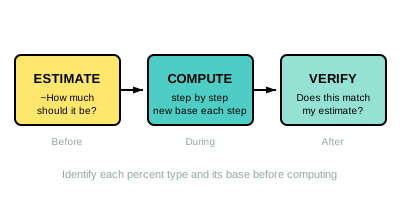
Before computing: Estimate — "About how much should the answer be?"
During: Identify and compute each percent step in sequence
After: Verify — "Does this answer make sense given my estimate?"
Worked Example: Restaurant Multistep Problem
Wholesale $4.00 · Markup 300% · Tax 8% · Tip 15%
- Menu:
- Post-tax:
- Tip:
- Total:
(estimate ~$20 ✓)
Worked Example: Salary and Interest
Salary $48,000 · Raise 6% · Deposit raise amount · Interest 3% for 4 years
Step 1: Raise
Step 2:
Step 1 base = salary | Step 2 base = raise amount
Check: Find the Original Price
After a 35% discount, a jacket costs $91. What was the original price?
Identify: What does $91 represent in terms of the original price?
Set up and solve.
Answer: Original Price Was $140
Check:
Guided Practice: Markup Then Discount
A store marks up its wholesale cost by 80%, then puts the item on sale for 30% off the marked-up price.
What is the actual percent change over the wholesale cost?
Hint:
Summary: Percent Change, Error, and Multistep
- Change =
— base is original - New value: original
| chain uses a different base each step - Error =
— base is actual
Wrong base | chained ≠ additive | measured ≠ denominator
Connections Across the Proportional Reasoning Unit
- 7.RP.A.1 — unit rates: the rate
in every percent formula is a unit rate - 7.RP.A.2 — proportional relationships: part
whole, = percent rate - 7.RP.A.3 — apply proportional reasoning to all real-world percent contexts
Coming next: ratios in scale drawings and geometric applications