Drawing Inferences from Random Samples
Work through each section in order. For short response questions, write complete sentences and show your reasoning.
Recall / Warm-Up
In a survey, 26 out of 40 randomly selected students say they have a pet. What proportion of the sample has a pet?
A teacher wants to estimate the favorite sport of all 7th graders in her school. Which sample is most likely to give a representative estimate?
A pollster randomly calls 200 registered voters and finds that 130 prefer Candidate A. What percent of the sample prefers Candidate A?
Fluency Practice
A random sample of 40 students shows that 26 have pets. The school has 800 students. Estimate how many students in the school have pets.
A factory's quality control team randomly tests 100 widgets and finds 4 are defective. The factory produces 10,000 widgets per day. About how many widgets per day are estimated to be defective?
A student draws 5 random samples from the same population and gets these proportions: 0.50, 0.55, 0.60, 0.65, 0.60. Which statement best describes these results?
A researcher randomly surveys 80 city residents and finds 52 use public transit regularly. Which statement CORRECTLY reports this finding as a population inference?
A librarian randomly selects 50 books from a collection of 2,000. She finds 12 need repairs. Estimate how many books in the full collection need repairs.
Varied Practice
Two random samples of 30 students from the same school give different estimates: Sample 1 shows 58% walk to school and Sample 2 shows 64% walk to school. What does this difference most likely indicate?
Researcher A randomly surveys 500 residents of City X, which has a population of 20,000. Researcher B randomly surveys 500 residents of City Y, which has a population of 2,000,000. Assuming both use proper random sampling, which survey produces more reliable estimates?
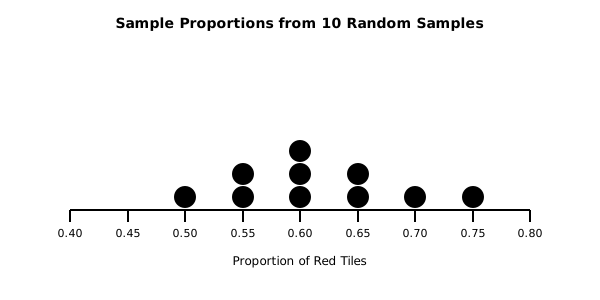
The dot plot below shows the proportion of red tiles found in 10 random samples, each of size 10, drawn from the same bag. Based on the dot plot, what is the best single estimate of the true proportion of red tiles in the bag?
You draw five random samples of size 10 from the same bag of tiles. The sample proportions are 0.60, 0.50, 0.70, 0.60, and 0.55. The ̲ ̲ ̲ ̲ ̲ ̲ ̲ ̲ ̲ ̲ ̲ ̲ ̲ ̲ ̲ ̲ ̲ ̲ ̲ ̲ ̲ ̲ consists of all the tiles in the bag. Based on these five samples, your best single estimate of the population proportion is ̲ ̲ ̲ ̲ ̲ ̲ ̲ ̲ ̲ ̲ ̲ ̲ ̲ ̲ ̲ ̲ ̲ ̲ ̲ ̲ ̲ ̲ .
Word Problems
A school is holding a student council election between two candidates. A pollster randomly calls 500 of the 12,000 registered student voters and finds that 310 prefer Candidate A.
What proportion of the surveyed voters prefer Candidate A? Express your answer as a percent.
Write an inference statement estimating how many of the 12,000 registered voters prefer Candidate A. Your statement must use appropriate hedging language to show this is an estimate.
A reporter stood outside a grocery store and asked 15 shoppers whether they shop there weekly. Thirteen said yes. The reporter concluded that 87% of all city residents shop at that grocery store weekly.
Is this inference trustworthy? Choose the best explanation.
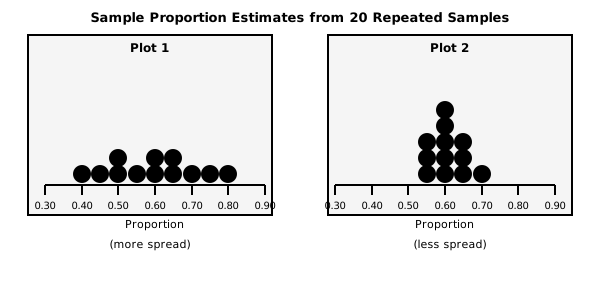
Two researchers each drew 20 random samples from the same population. Researcher A used samples of size 5; Researcher B used samples of size 20. Their results are shown in the dot plots below.
(a) Which dot plot — Plot 1 or Plot 2 — corresponds to Researcher B's larger samples? Explain how you can tell. (b) Explain how sample size affects the spread of estimates and what that means for the reliability of a single estimate.
A principal wants to estimate what fraction of 900 students at her school bring lunch from home. Which approach gives the MOST reliable estimate?
Error Analysis
Marcus randomly surveyed 30 people at a community center and found that 18 preferred Brand X over Brand Y. He reported his results this way:
"I surveyed 30 people and 18 preferred Brand X. Therefore, 60% of all people prefer Brand X."
What error did Marcus make in his conclusion?
Sofia drew one random sample of 40 tiles from a bag and found that 22 were red. She then concluded:
"My sample proportion is . So the population proportion of red tiles is exactly 0.55."
What error did Sofia make?
Challenge
A principal wants to know what fraction of her school's 1,200 students walk to school. Design a complete sampling study. Your response must address: (a) the population, (b) a specific random sampling method with a stated sample size, (c) how you would use multiple samples to gauge the variability in your estimate, and (d) how you would state your final inference.
Two groups surveyed voters about a school bond measure. Group A randomly selected 60 voters from the official voter list and found 54% in favor. Group B posted an online survey and received 200 volunteer responses showing 72% in favor. Which result is more reliable? Give at least two specific reasons in your explanation.