Experimental Probability: Measuring, Predicting, and Comparing
Express experimental probabilities as fractions or decimals between 0 and 1. Show all computations. When estimating frequencies, note that your answer is a prediction, not a guarantee.
Recall / Warm-Up
A spinner is spun 50 times. It lands on 'blue' 18 times. Which fraction correctly represents the relative frequency of blue?
Express as a decimal. Round to the nearest thousandth.
A store sells 300 items in a day. If 0.6 of the items are clothing, how many clothing items were sold?
Fluency
A coin is flipped 80 times. Heads appeared 34 times. Compute the experimental probability of heads as a decimal.
A standard 6-sided die is rolled 180 times. How many times would you expect to roll a 4?
Which statement correctly defines experimental probability?
A spinner is spun 120 times. Results: Red = 42 times, Blue = 38 times, Green = 40 times. Compute the experimental probability of Red as a fraction in lowest terms.
Which statement best describes what 'long-run relative frequency' means in probability?
Varied Practice
Which statement correctly distinguishes theoretical probability from experimental probability?
A student is asked for the experimental probability of rolling a 5. After 60 trials, a 5 appeared 11 times. The student writes: 'The experimental probability is 11.' What error did the student make?
A thumbtack has experimental P(point-up) = 0.40. Flipped 250 times, the expected number of point-up results is ̲ ̲ ̲ ̲ ̲ ̲ ̲ ̲ ̲ ̲ ̲ ̲ ̲ ̲ ̲ ̲ ̲ ̲ ̲ ̲ ̲ ̲ . If instead P(point-up) = 0.65 and , the expected count is ̲ ̲ ̲ ̲ ̲ ̲ ̲ ̲ ̲ ̲ ̲ ̲ ̲ ̲ ̲ ̲ ̲ ̲ ̲ ̲ ̲ ̲ .
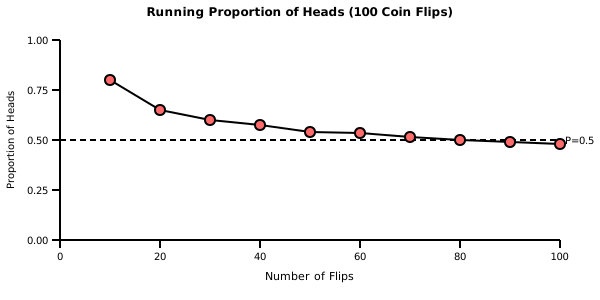
The graph shows the running proportion of heads during 100 coin flips. The proportion starts high (around 0.8) after the first 10 flips, then gradually decreases and stabilizes. Which conclusion is best supported by this graph?
Word Problems
A student draws colored tiles from a bag with replacement 50 times. Results: Blue = 24 times, Red = 16 times, Yellow = 10 times.
Compute the experimental probability of drawing a Blue tile as a decimal.
The bag was designed so that the theoretical probability of blue is 0.40. Compare this to the experimental result of 0.48. Is this discrepancy concerning? Explain your reasoning.
The theoretical probability of rolling an even number on a standard 6-sided die is . If the die is rolled 240 times, predict the approximate number of even-number rolls.
A student flips a fair coin 10 times and gets tails 8 times. The student says: 'The next few flips must be mostly heads to balance things out.' (a) What is the Gambler's Fallacy? (b) Why is the student's reasoning incorrect?
A student rolls a standard 6-sided die 6 times and does not roll a 6 in any of the 6 rolls. The student concludes: 'This die is definitely unfair — the 6 is blocked.' Is this conclusion justified?
Error Analysis
A student knows that P(red tile) = 0.25. The student draws tiles 40 times with replacement and gets 7 red tiles. The expected count was reds.
The student writes: "This experiment must be wrong — I should have gotten exactly 10 reds since . The data is invalid."
What error did the student make? What does P × n actually tell us?
A student is asked to estimate the probability of a spinner landing on green. After 90 spins, the spinner landed on green 27 times.
The student writes: "P(green) is about 27."
What error did the student make? What is the correct experimental probability?
Challenge
A die is rolled 600 times. The results are:
Face 1: 89 times, Face 2: 95 times, Face 3: 102 times,
Face 4: 105 times, Face 5: 98 times, Face 6: 111 times.
(a) Compute the experimental probability for each face. Round to three decimal places.
(b) Verify that the six probabilities sum to 1.
(c) The theoretical probability of each face is . Compare each experimental value to 0.167.
(d) Based on this data, does the die appear to be fair or biased? Explain your reasoning.
You want to estimate the probability that a thumbtack lands point-up when dropped.
(a) Describe a specific experiment you would design to estimate this probability.
(b) After 50 flips, 22 land point-up. What is your experimental probability estimate?
(c) After 500 additional flips, 190 more land point-up. Compute your updated estimate using all 550 total flips.
(d) Which estimate — part (b) or part (c) — is more reliable? Explain why.