Probability Models: Uniform and Non-Uniform
Recall
Which set correctly represents the complete sample space when rolling a standard six-sided die?
A probability model has exactly three outcomes: A, B, and C. The model assigns and . All probabilities must sum to 1. What is ?
A die is rolled 60 times. Face 4 appears 12 times. Express the relative frequency of face 4 as a decimal.
Fluency
Which of the following is a valid probability model for a spinner with three colors?
A fair 8-sided die has faces numbered 1 through 8. All outcomes are equally likely. Using a uniform probability model, compute the probability of rolling a number greater than 5. Express your answer as a fraction.
A bag contains 4 red tiles, 6 blue tiles, and 2 green tiles. One tile is selected at random; every tile is equally likely to be chosen. Using a uniform probability model, compute as a fraction in lowest terms.
A spinner is spun 80 times. Results: Red = 28, Blue = 32, Yellow = 20. Build a non-uniform probability model from this data. What is expressed as a decimal?
A non-uniform spinner model assigns , , and . What is the probability of landing on Red or Blue?
Varied Practice
A student rolls a 4-sided die with faces labeled A, B, C, and D, and writes . When is this a valid application of the uniform probability model?
A probability model predicts that Red will appear 30 times in 100 spins. In an actual experiment, Red appears 27 times. A student claims the model is wrong because the prediction did not match. Is the student correct? Explain your reasoning.
A student creates a probability model for rolling a standard six-sided die: . What is the error in this model?
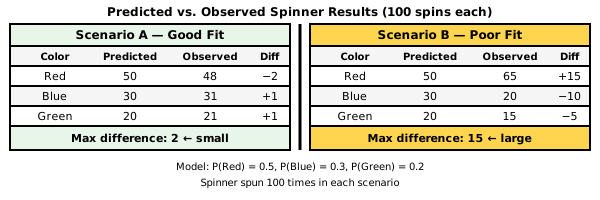
The table shows two experiments using the same spinner model (, , ) compared to observed data from 100 spins each. In which scenario does the model fit better, and why?
Word Problems
A loaded die is rolled 120 times. The outcome frequencies are: Face 1: 15 times, Face 2: 18 times, Face 3: 25 times, Face 4: 20 times, Face 5: 22 times, Face 6: 20 times.
Use the frequency data to answer both parts below.
Build a non-uniform probability model from the data. What is ? Round your answer to the nearest thousandth.
Using this non-uniform model, what is ? Express your answer as a fraction in lowest terms.
A special card deck contains only 8 red cards, 4 blue cards, and 4 green cards. Every card is equally likely to be drawn. Using a uniform probability model, compute the probability of drawing a card that is not red. Express your answer as a fraction in lowest terms.
A student draws 20 marbles from a bag with replacement and records: Red = 3, Blue = 12, Yellow = 5. She builds a non-uniform probability model: , , . She says she is very confident this model accurately represents the bag. Is this confidence justified? Explain.
A spinner model predicts , , . A student spins 200 times and gets: Red = 78, Blue = 71, Green = 51. The predicted frequencies are: Red = 80, Blue = 70, Green = 50. Which conclusion is best supported?
Error Analysis
A student is asked to find the probability that a thumbtack lands
point-up when dropped. The student reasons: "There are two possible
outcomes — the thumbtack either lands point-up or point-down. Since
there are two outcomes, P(point-up) = 1/2."
What error did the student make?
A student builds a probability model: , ,
. The student runs an experiment with 50 trials and
observes: A = 22, B = 15, C = 13. Expected: A = 20, B = 17, C = 13.
The student writes: "My model is wrong — I expected A = 20 and B = 17,
but I got A = 22 and B = 15."
What error did the student make?
Challenge
A spinner is spun 400 times with results: Red = 180, Blue = 110, Green = 70, Yellow = 40.
(a) Build a non-uniform probability model. Express each probability as a decimal.
(b) Verify that the four probabilities sum to 1.
(c) Using your model, find .
(d) A second spinner has 4 equal sections labeled Red, Blue, Green, and Yellow. For that spinner's uniform model, what is ? Why do the two models give different answers?
A probability model for a 4-color spinner: , , , .
In an experiment with 200 spins, the results are: Red = 52, Blue = 83, Green = 42, Yellow = 23.
(a) Compute the predicted frequency for each color (use ).
(b) Find the difference (observed − predicted) for each color.
(c) Do these data suggest the model is accurate? Justify your answer by discussing which colors fit well and which may be cause for concern.