Compound Events: Sample Spaces and Simulation
Recall
A coin has 2 outcomes (H, T) and a six-sided die has 6 outcomes (1–6). If you flip the coin AND roll the die at the same time, how many outcomes are in the combined sample space?
Which of the following is an example of a compound event?
A combined sample space contains 20 equally likely outcomes. An event consists of 5 of these outcomes. What is the probability of the event? Express your answer as a fraction in lowest terms.
Fluency
A coin is flipped (outcomes: H, T) and a 4-sided die with faces 1, 2, 3, 4 is rolled. How many outcomes are in the combined sample space?
The sample space for flipping a coin then rolling a 4-sided die is: Compute as a fraction in lowest terms.
A spinner with 3 equal sections (Red, Blue, Green) is spun twice. A tree diagram is drawn: the first spin creates 3 branches; each branch splits into 3 branches for the second spin. How many complete paths (outcomes) does the finished tree have?
Three coins are flipped. The complete sample space is: Find as a fraction.
Using the same 3-coin sample space , find as a fraction.
Varied Practice
A student records outcomes for flipping a coin then rolling a 4-sided die. She writes two labels: and . She claims these are two different outcomes. Is she correct?
A tree diagram for flipping a coin twice is drawn. After the first flip, there are 2 branches: H and T. A student says: "There are 2 outcomes in the sample space." What error did the student make?
A 6-sided die (faces 1–6) and a 4-sided die (faces 1–4) are rolled together. The combined sample space has ̲ ̲ ̲ ̲ ̲ ̲ ̲ ̲ ̲ ̲ ̲ ̲ ̲ ̲ ̲ ̲ ̲ ̲ ̲ ̲ ̲ ̲ outcomes. If an event consists of all pairs where both dice show the same number (e.g., , , …), then ̲ ̲ ̲ ̲ ̲ ̲ ̲ ̲ ̲ ̲ ̲ ̲ ̲ ̲ ̲ ̲ ̲ ̲ ̲ ̲ ̲ ̲ outcomes satisfy this event.
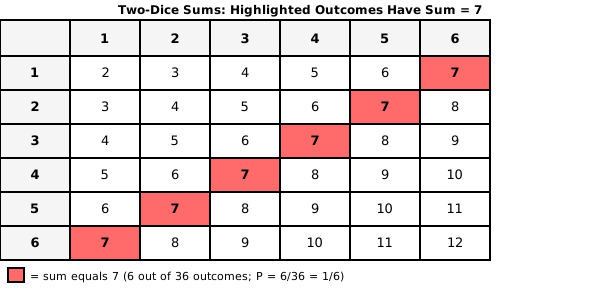
The table shows all 36 outcomes from rolling two standard six-sided dice, with the sum of each pair displayed. The cells highlighted in red show outcomes where the sum equals 7. What is ?
Word Problems
A spinner has 3 equal sections: Red (R), Blue (B), and Green (G). A coin has 2 sides: Heads (H) and Tails (T). The spinner is spun once and the coin is flipped once.
Use the spinner and coin setup to answer both parts below.
List all outcomes in the combined sample space for this experiment. How many outcomes are there?
Using this sample space, find the probability that the spinner lands on Blue or Green AND the coin shows Tails. Express your answer as a fraction in lowest terms.
A basketball player makes free throws 60% of the time. You want to estimate the probability that she makes both shots in a 2-shot free throw opportunity.
(a) Describe the random mechanism you would use for the simulation (e.g., a 10-sided die numbered 1–10).
(b) Define what counts as one complete trial.
(c) Define what counts as a success.
(d) After running 50 trials, you record 17 successes. What is your simulation estimate of the probability? The theoretical probability is . Is your estimate consistent with this? Explain.
Two 4-sided dice, each with faces 1, 2, 3, 4, are rolled together. The combined sample space has 16 equally likely outcomes. Find as a fraction in lowest terms.
A student designs a simulation to estimate . She runs 40 trials and records "at least 2 tails" in 14 of them.
(a) What is her simulation estimate of the probability?
(b) The theoretical probability is
Her estimate is 0.35. Is this result consistent with a correct simulation? Explain.
Error Analysis
A student finds P(doubles) when rolling two standard six-sided dice.
The student lists these outcomes:
(1,1), (2,2), (3,3), (4,4), (5,5), (6,6), (1,2), (2,1)
The student writes: "There are 8 total outcomes, so P(doubles) = 6/8."
What errors did the student make?
A student is asked to find P(at least 2 tails in 3 coin flips).
The sample space is:
{HHH, HHT, HTH, HTT, THH, THT, TTH, TTT}
The student lists the favorable outcomes as: {HTT, THT, TTH}
and writes: "P(at least 2 tails) = 3/8."
What error did the student make?
Challenge
A spinner has 4 equal sections labeled A, B, C, and D. It is spun twice.
(a) How many outcomes are in the combined sample space?
(b) Construct the complete sample space using an organized list or table.
(c) Find .
(d) Find .
A 3-section spinner with equal sections (Red, Blue, Yellow) is spun twice.
(a) Construct the complete sample space in a table.
(b) Find .
(c) Using a standard 6-sided die, design a simulation: assign die faces to spinner outcomes (for example, 1–2 = Red, 3–4 = Blue, 5–6 = Yellow). Describe one complete simulation trial and define what counts as "success."
(d) After 60 trials, 18 show "same color" outcomes. What is the simulation estimate of ? How does it compare to the theoretical value from part (b)?