Exercises: Rearrange Formulas to Highlight a Quantity of Interest
Show each algebraic step clearly. State which operation you apply to both sides at each step.
Warm-Up: Review What You Know
These problems review skills you have already learned.
Solve for .
The equation is solved for . Which expression gives ?
In the formula , you want to solve for . Which statement best describes how to treat ?
Fluency Practice
Rearrange each formula to solve for the indicated variable. Show your steps.
Ohm's Law: . Rearrange to solve for . Then find when volts and amps. Give your answer in ohms.
Perimeter of a rectangle: . Rearrange to solve for . Then find when cm and cm. Give your answer in centimetres.
Distance formula: . Rearrange to solve for . Then find when miles and miles per hour. Give your answer in hours.
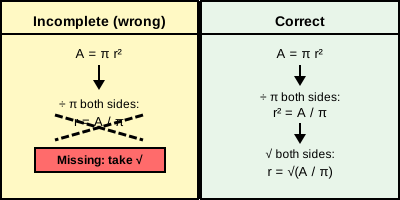
Area of a circle: . Rearrange to solve for (take the positive root). Then find when cm². Give your answer in centimetres.
Simple interest total: , where is the principal, is the annual rate, and is time in years. Which expression correctly gives in terms of , , and ?
Varied Practice
These problems present formula rearrangement in different ways.
Newton's second law: . Which expression correctly solves for ?
Simple interest formula: . Rearrange to solve for .
Step 1 — Divide both sides by :
Step 2 — Substitute , , to find :
Ideal gas law: . A scientist knows , , , and but needs to find . Which rearranged form should the scientist use?
A student says: "Solving for is a completely different type of problem from solving because the first equation has two letters." Is the student correct?
Application Problems
For each problem, identify the formula, rearrange it to solve for the unknown, then substitute and compute. Include units in your final answer.
A car travels 270 miles in 4.5 hours at a constant speed.
Use the formula to find the car's average speed in miles per hour.
An investment earns $90 in simple interest over 3 years. The principal is $500.
Use the formula to find the annual interest rate . Express your answer as a decimal.
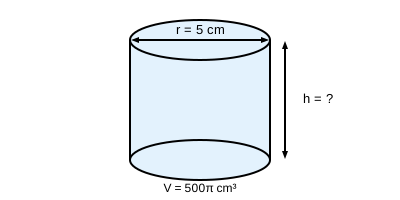
A cylindrical water tank has a volume of cubic centimetres and a radius of 5 cm.
Use the formula . Rearrange the formula to solve for . Write the rearranged formula.
Enter the coefficient of in the rearranged formula (give the expression in the denominator as a plain expression, e.g., "pi r^2").
Using , find the height in centimetres when cm³ and cm.
Error Analysis
Each problem shows a student's work that contains an error. Identify the mistake.
Jordan solved for :
- Divide both sides by :
- Therefore ✓
Jordan concludes Step 3 is correct.
Is Jordan's work valid? If not, what is the error in Step 2?
Sam solved for :
- Divide both sides by :
- Answer:
What error did Sam make?
Challenge / Extension
These problems go beyond the core skill. Try them if you finish early or want an extra challenge.
Kinematics formula: , where is final velocity, is initial velocity, is acceleration, and is distance.
Rearrange to solve for (take the non-negative root). Then find when m/s, m/s², and m.
Give your answer in m/s (exact value, or simplify if possible).
Explain in your own words why solving for uses exactly the same reasoning as solving . What role do and play in the formula rearrangement?