Exercises: Solving for Inverse Functions
Show all algebraic steps for each problem. Write inverse functions using $f^{-1}(x)$ notation.
Warm-Up: Review What You Know
These problems review skills you have already learned.
If and are inverse functions, which of the following must be true?
Solve the equation for .
For , what is the value of when ?
Fluency Practice
Find the inverse of each function. Show your steps.
Find for .
Express your answer in the form .
Enter just the value of (the number added in the numerator).
Find for .
Enter the coefficient of in the expression for .
(For example, if , enter 2.)
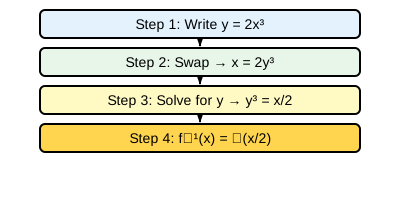
Find for .
Enter the denominator of the expression under the cube root in .
(For example, if , enter .)
Let with domain .
Which of the following is ?
Find for , where .
After applying the swap-and-solve method, the inverse is of the form
.
Enter the value of .
Varied Practice
A student starts finding for and writes:
"Step 1: . Step 2: Solve for : .
Therefore ."
The student's answer is incomplete. What must they do next?
Complete the swap-and-solve steps for .
Step 1: Write .
Step 2: Swap and : .
Step 3: Subtract ̲ ̲ ̲ ̲ ̲ ̲ ̲ ̲ ̲ ̲ ̲ ̲ ̲ ̲ ̲ ̲ ̲ ̲ ̲ ̲ ̲ ̲ from both sides: .
Step 4: Divide both sides by ̲ ̲ ̲ ̲ ̲ ̲ ̲ ̲ ̲ ̲ ̲ ̲ ̲ ̲ ̲ ̲ ̲ ̲ ̲ ̲ ̲ ̲ : .
Which of the following functions does NOT have an inverse on its natural domain (all real numbers)?
Consider , — the standard example from HSF.BF.B.4.a.
A student finds the inverse and gets .
The student says, "My answer must be wrong — the inverse can't equal the original function."
Is the student correct?
Find for . Then verify your answer by computing and showing it equals .
Word Problems
A bakery uses the formula to calculate the total cost (in dollars) of ordering custom cookies.
Solve to find how many cookies can be ordered for exactly $16.
Find the inverse function and use it to verify your answer from part (a).
Enter the coefficient of in the expression for .
(For example, if , enter .)
A sculptor uses the formula to calculate the volume (in cubic inches) of a spherical clay bead with radius (in inches). She wants a bead with volume 54 cubic inches.
Find by using the inverse of . Enter your answer as a whole number.
A student claims that the function converts temperature in one scale to another.
Find and use it to determine which input gives .
Enter the value of as a whole number.
Error Analysis
Each problem shows a student's work that contains an error. Identify and explain the mistake.
Maya found the inverse of :
- Write .
- Solve for : .
- Therefore .
What error did Maya make?
Tyler found the inverse of :
- Swap: .
- Cross-multiply: .
- Expand: .
- Collect : .
- Hmm, I messed up the sign — let me just write .
Tyler made a sign error in step 4. What should the right side of step 4 be?
Challenge / Extension
These problems require multi-step reasoning. They are bonus problems.
Let .
Find . The inverse is of the form .
Enter the value of .
Explain why does not have an inverse on its natural domain, but does have an inverse when the domain is restricted to . In your response:
- State why fails the one-to-one requirement on all reals (give a specific example).
- Find on the restricted domain .
- Verify your inverse by showing .