Exercises: Graphing Exponential, Logarithmic, and Trigonometric Functions
Show your work for each problem. Identify all key features as directed.
Warm-Up: Review What You Know
These problems review skills you have already learned.
Which of the following expressions is equivalent to ?
The graph of is shifted down 5 units. What is the equation of the transformed function?
The parent function has a maximum value of 1 and a minimum value of .
What is the amplitude of the parent sine function?
Fluency Practice
Apply the graphing procedures and identify key features.
For the exponential function , what is the -intercept?
The function has a horizontal asymptote.
What is the -value of the horizontal asymptote?
Which of the following correctly states the domain and range of ?
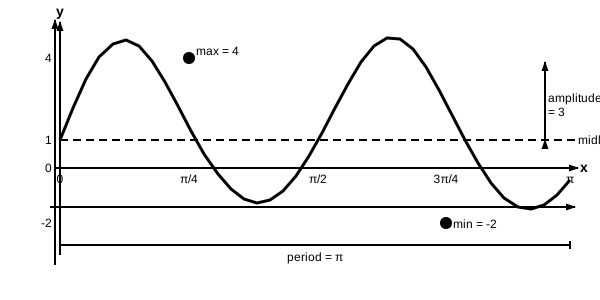
For the function , what is the amplitude?
What is the period of the function ?
Express your answer as a number.
Varied Practice
These problems present the same skills in different formats.
The graph of an exponential function passes through , , and .
Which equation best represents this function?
Which statement correctly distinguishes exponential growth from exponential decay for
functions of the form (with , )?
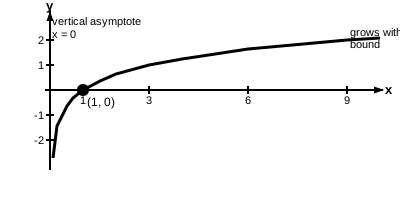
For the function , complete the key features:
The vertical asymptote is at ̲ ̲ ̲ ̲ ̲ ̲ ̲ ̲ ̲ ̲ ̲ ̲ ̲ ̲ ̲ ̲ ̲ ̲ ̲ ̲ ̲ ̲ .
The -intercept is at the point ( ̲ ̲ ̲ ̲ ̲ ̲ ̲ ̲ ̲ ̲ ̲ ̲ ̲ ̲ ̲ ̲ ̲ ̲ ̲ ̲ ̲ ̲ , ̲ ̲ ̲ ̲ ̲ ̲ ̲ ̲ ̲ ̲ ̲ ̲ ̲ ̲ ̲ ̲ ̲ ̲ ̲ ̲ ̲ ̲ ).
The domain is ̲ ̲ ̲ ̲ ̲ ̲ ̲ ̲ ̲ ̲ ̲ ̲ ̲ ̲ ̲ ̲ ̲ ̲ ̲ ̲ ̲ ̲ .
The graphs of and are reflections of each other.
Over which line are they reflected?
For the function , which set of values is correct?
Word Problems
Apply your knowledge of function families to real-world contexts.
A bacterial culture starts with 200 cells and doubles every hour.
The number of cells after hours is modeled by .
The horizontal asymptote limits the model's output as .
Enter the -value of the horizontal asymptote.
The loudness (in decibels) of a sound is modeled by
where is the sound intensity and is the reference intensity.
A sound has intensity .
What is the loudness in decibels?
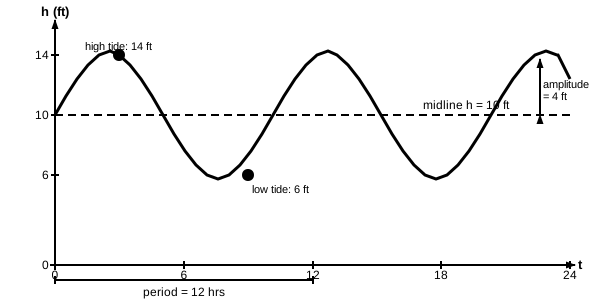
Ocean tides at a harbor can be modeled by the function
where is the water depth in feet and is the time in hours after midnight.
What is the amplitude of the tidal function in feet?
What is the period of the tidal function in hours?
Error Analysis
Each problem shows a student's work that contains an error. Identify the mistake.
A student was asked to compare and for large values of .
They wrote:
"Both functions grow the same way — they both curve upward faster and faster. By , they are both very large, so they are the same type of function."
What error did the student make?
A student graphed and concluded:
"The graph clearly flattens out as increases. Since it appears to level off, the function has a horizontal asymptote at (it never goes above 3 on my graph window)."
What is wrong with the student's reasoning?
Challenge / Extension
These problems extend your thinking and connect to future topics.
The function and the function are inverse functions.
Explain, using the concept of swapping inputs and outputs, why the graph of is
the reflection of the graph of over the line .
Include at least one specific coordinate pair from each graph in your explanation.
A sine function has amplitude 6, period , and midline .
The function is of the form with and .
What is the maximum value of this function?