Exercises: Extend Trigonometric Functions Using the Unit Circle
Show all steps for each problem. Leave answers involving square roots in exact form (e.g., $\frac{\sqrt{2}}{2}$) unless otherwise stated.
Warm-Up: Review What You Know
These problems review skills you have already learned.
In a right triangle with hypotenuse 1, if is the angle at the origin, which of the following correctly describes using right-triangle trigonometry?
Which radian measure is equivalent to 270°?
A point has coordinates in the coordinate plane. In which quadrant is located?
Fluency Practice
Evaluate each expression using the unit circle. Give exact values.
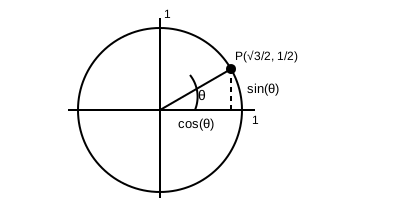
The terminal side of angle in standard position intersects the unit circle at the point . What is ?
The angle has its terminal side in Quadrant II. What are the signs of and ?
Use the reference angle strategy to evaluate . Give an exact answer.
Use the reference angle strategy to evaluate . Give an exact answer.
Evaluate . Give an exact answer.
Varied Practice
These problems use the same skills in different ways.
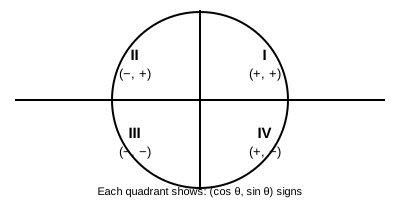
In which quadrant(s) is and simultaneously?
The angle is in Quadrant ̲ ̲ ̲ ̲ ̲ ̲ ̲ ̲ ̲ ̲ ̲ ̲ ̲ ̲ ̲ ̲ ̲ ̲ ̲ ̲ ̲ ̲ . Its reference angle is ̲ ̲ ̲ ̲ ̲ ̲ ̲ ̲ ̲ ̲ ̲ ̲ ̲ ̲ ̲ ̲ ̲ ̲ ̲ ̲ ̲ ̲ . Therefore and .
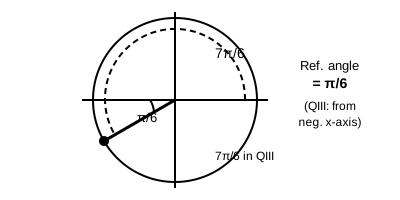
The diagram shows the angle and its reference angle. Use the reference angle to evaluate .
Which of the following correctly evaluates ?
What is the reference angle (in radians) for ? Give your answer as a fraction involving .
Word Problems
Read each problem carefully. Use the unit circle to find exact values.
A Ferris wheel has a radius of 1 meter and its center at the origin. A car starts at the rightmost point and travels counterclockwise. When the car has traveled an arc length equal to meters, what is the car's height above or below the center? (A positive answer means above the center.)
Find the car's height, which equals . Give an exact answer.
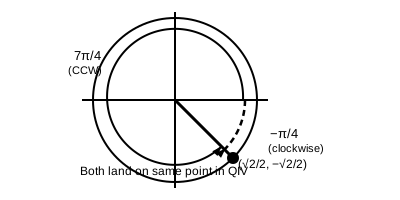
A clock pendulum swings past the lowest point and is modeled on the unit circle. The angle represents a clockwise swing of radians from the starting position at .
What is ? Give an exact answer.
A particle travels counterclockwise around the unit circle starting at . After traveling an arc of radians, the particle is at a new position.
What is the -coordinate of the particle's position? This equals . Give an exact answer.
What is the -coordinate of the particle's position? This equals . Give an exact answer.
Error Analysis
Each problem shows a student's work that contains an error. Identify the mistake.
Jordan evaluated as follows:
"The angle is in Quadrant II. The adjacent side is always positive because it is a length. So ."
What is the error in Jordan's reasoning?
Alex evaluated and :
"The angle is negative, so both sine and cosine must be negative. and ."
Alex's final numerical values are actually correct, but the reasoning is wrong. Which statement best explains why?
Challenge / Extension
These problems require multiple steps or deeper reasoning. Try them if you have mastered the core problems.
Evaluate . Show the steps: (1) find a coterminal angle in , (2) identify the quadrant and reference angle, (3) attach the correct sign.
Explain in your own words why the unit circle allows sine and cosine to be defined for any real number, not just angles between 0 and . Your explanation should address: (1) what happens when you go past , (2) what happens with angles greater than , and (3) what happens with negative angles.