Exercises: Exact Trigonometric Values from Special Triangles
Use special triangles and unit circle symmetry. Express all answers in exact form (no decimals).
Warm-Up: Review What You Know
These problems review skills you have already learned.
A right triangle has legs of length 3 and 4. What is the length of its hypotenuse?
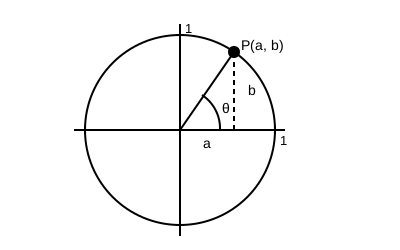
A point lies on the unit circle at angle . Its coordinates are . Which statements are correct?
The terminal side of angle lies in the third quadrant. What is its reference angle? Express your answer in the form (e.g., pi/4).
Fluency Practice
Find the exact value. Show the special triangle you used.
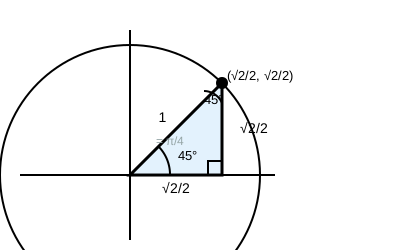
A 45-45-90 triangle is placed in the unit circle with its hypotenuse along the radius to angle . Each leg has length . What is ?
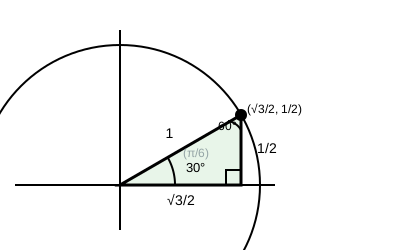
An equilateral triangle with side length 2 is bisected to form a 30-60-90 triangle with sides 1, , and 2. When scaled to hypotenuse 1 and placed in the unit circle at angle , what is ?
Using the 30-60-90 triangle on the unit circle, find the exact value of .
Find the exact value of . Express your answer as a fraction with a rational denominator.
Complete the unit circle coordinates for the three first-quadrant special angles:
- Angle : point
- Angle : point
- Angle : point
Varied Practice
Which of the following gives the correct exact value of ?
A student claims that . Is this correct?
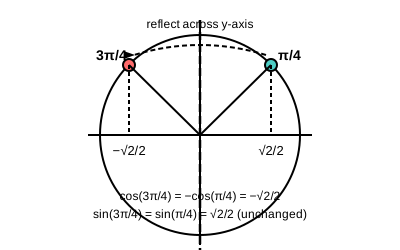
Using the symmetry relation , find the exact value of .
Find the exact value of by identifying its reference angle and quadrant.
A point at angle in the first quadrant has coordinates . A classmate says: "The point at angle has coordinates because we negate the x-coordinate when moving to a new quadrant." Is the classmate correct? Explain using the unit circle.
Word Problems
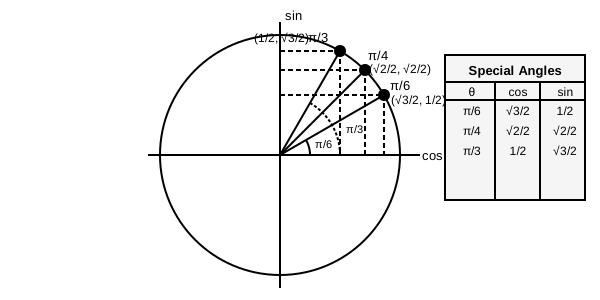
A surveyor uses a clinometer to measure angles. At angle from the horizontal, the instrument's unit-radius dial reads coordinates directly from the unit circle.
At angle , what exact y-coordinate (sine value) does the dial read?
The surveyor then rotates to angle . What exact x-coordinate (cosine value) does the dial read?
A ramp rises at an angle of from the horizontal. The ramp's length (hypotenuse) is 10 meters.
What is the exact vertical rise of the ramp in meters?
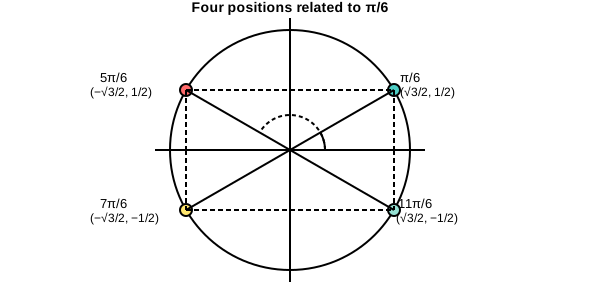
A Ferris wheel has radius 1 unit and a passenger's position is modeled by the unit circle. The passenger starts at angle and the wheel rotates to new positions.
After the wheel rotates to angle , what is the passenger's exact height (y-coordinate)?
At angle , what is the passenger's exact height (y-coordinate)?
Error Analysis
Each problem shows a student's work that contains an error. Identify the mistake.
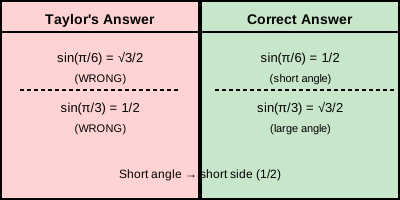
Taylor evaluated and :
What mistake did Taylor make?
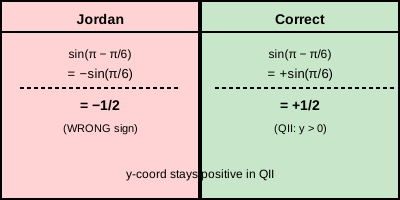
Jordan evaluated using the symmetry relation:
What error did Jordan make when applying the symmetry relation
Challenge / Extension
These problems extend the core ideas. Try them if you've finished the rest.
Find the exact value of . Express your answer as a fraction with a rational denominator (or as an integer if it simplifies).
Without using the pattern, derive the exact value of from scratch using only the Pythagorean theorem and the definition of the unit circle. Explain each step.