Exercises: Choosing Trigonometric Functions to Model Periodic Phenomena
Show your work for each problem. Express answers involving pi using exact form (e.g., pi/4) unless otherwise stated.
Warm-Up: Review What You Know
These problems review skills you have already learned.
In the function , what is the period?
Which transformation moves the graph of up 3 units?
At , a quantity is at its maximum value and then decreases. Which function best describes this starting behavior?
Fluency Practice
Practice the core skills of this lesson.
What is the amplitude of ?
What is the period of ?
Express your answer as a whole number.
What is the midline of ?
Give the -value of the midline as a whole number.
A periodic phenomenon has a maximum value of 40 and a minimum value of 10. What is the amplitude?
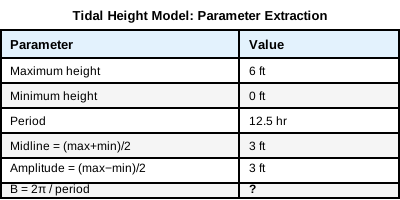
A tide has a maximum height of 6 feet and a minimum height of 0 feet, completing one full cycle every 12.5 hours.
What is the value of in the sinusoidal model? Enter as a decimal rounded to three decimal places.
A pendulum displacement starts at its maximum positive value at . The amplitude is 8 cm, the period is seconds, and the midline is . Which equation models this?
Varied Practice
Practice the same skills in different formats and representations.
A sinusoidal function has a maximum of 9 and a minimum of 1, and completes one cycle over an interval of length . Which function matches these features?
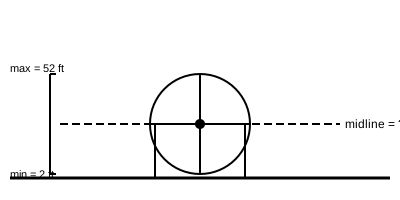
A Ferris wheel has a maximum height of 52 feet and a minimum height of 2 feet.
What is the midline (vertical center) of the height function, in feet? Give your answer as a whole number.
A buoy bobs up and down. At it is at its midline moving upward. The amplitude is 3 ft, period is 8 s, and midline is .
The model has the form . Fill in the values: $A = $ ̲ ̲ ̲ ̲ ̲ ̲ ̲ ̲ ̲ ̲ ̲ ̲ ̲ ̲ ̲ ̲ ̲ ̲ ̲ ̲ ̲ ̲ , $D = $ ̲ ̲ ̲ ̲ ̲ ̲ ̲ ̲ ̲ ̲ ̲ ̲ ̲ ̲ ̲ ̲ ̲ ̲ ̲ ̲ ̲ ̲ , and $B = $ ̲ ̲ ̲ ̲ ̲ ̲ ̲ ̲ ̲ ̲ ̲ ̲ ̲ ̲ ̲ ̲ ̲ ̲ ̲ ̲ ̲ ̲
A solar panel angle starts at its maximum of 90° at and decreases to a minimum of 0°, completing one full cycle in 24 hours. Which function is the simplest model?
In the model , what does the value 27 represent in the context of a Ferris wheel where is height in feet and is time in minutes?
Using the Ferris wheel model , what is the height (in feet) at minutes?
Give your answer as a whole number.
Word Problems
Apply your skills to real-world situations. Show your work.
The average monthly temperature in a city ranges from a high of 85°F in July to a low of 25°F in January. Assume the temperature follows a sinusoidal model with a 12-month period.
What is the amplitude of the temperature model, in degrees Fahrenheit? Give your answer as a whole number.
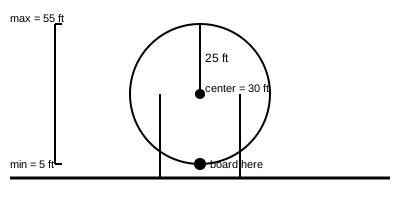
A Ferris wheel has a diameter of 50 feet. Its center is 30 feet above the ground. Riders board at the bottom of the wheel. The wheel completes one full revolution every 6 minutes.
What is the midline of the height function? Give your answer in feet as a whole number.
Since riders board at the bottom at , which function correctly models the height?
Using the model , what is the height of a rider after 1.5 minutes?
Give your answer in feet as a whole number.
Ocean water temperature at a buoy follows a sinusoidal model. The temperature reaches a maximum of 22°C and a minimum of 14°C, completing one cycle every 24 hours. At hours, the temperature is at its maximum.
Write a cosine model for the temperature, then evaluate it at hours.
What is the temperature in °C at hours? Give your answer as a whole number.
Error Analysis
A student made an error in each problem below. Identify the mistake.
Mia is given and writes:
"The period is , the amplitude is 5, and the midline is ."
What error did Mia make?
Marcus models a Ferris wheel with maximum height 48 ft and minimum height 8 ft. He writes:
"Amplitude because the function starts at the minimum and I used , so ."
What is wrong with Marcus's reasoning?
Challenge / Extension
These problems go beyond the core lesson. Try them if you want an extra challenge.
A sound wave has pressure function where is in pascals and is in seconds.
A second sound wave has twice the amplitude and half the frequency of the first. What is the period of the second wave, in seconds? Give your answer as a fraction in simplest form.
Two students model the same Ferris wheel (max height 52 ft, min height 2 ft, period 8 min, riders board at the midline going upward):
- Student A:
- Student B:
Are both models correct for the given starting condition? Explain by checking each at .