Pythagorean Identity: Proof and Applications
Recall / Warm-Up
On the unit circle, a point at angle has coordinates .
Which of the following correctly identifies and ?
In which quadrant are both and negative?
The unit circle is the set of all points satisfying a specific
equation. A point on the unit circle satisfies $x^{2} + y^{2} = $ ̲ ̲ ̲ ̲ ̲ ̲ ̲ ̲ ̲ ̲ ̲ ̲ ̲ ̲ ̲ ̲ ̲ ̲ ̲ ̲ ̲ ̲ .
Enter your answer.
Fluency Practice
Given and is in Quadrant I, use
the Pythagorean identity to find . Express your answer as
a fraction in simplest form.
Given and is in Quadrant III,
use the Pythagorean identity to find . Express your answer
as a fraction in simplest form.
Given and is in Quadrant II,
use the Pythagorean identity to find . Express your answer
in simplest radical form (e.g., write sqrt(5)/3 for ).
Given and is in Quadrant I, find
. Express your answer as a fraction in simplest form.
(Hint: first find , then use .)
Given and is in Quadrant II, find
. Express your answer as a fraction in simplest form.
Varied Practice
A student says the Pythagorean identity
is only valid for special angles like , ,
and because those are the only angles with exact values.
Which response best refutes this claim?
The expression means , NOT
.
For :
, so
̲ ̲ ̲ ̲ ̲ ̲ ̲ ̲ ̲ ̲ ̲ ̲ ̲ ̲ ̲ ̲ ̲ ̲ ̲ ̲ ̲ ̲ .
Then ̲ ̲ ̲ ̲ ̲ ̲ ̲ ̲ ̲ ̲ ̲ ̲ ̲ ̲ ̲ ̲ ̲ ̲ ̲ ̲ ̲ ̲ .
If and is in Quadrant II, which
of the following is the correct value of ?
The Pythagorean identity can be verified for any angle. Use it to
verify the identity at .
Recall: and
.
Compute .
Enter your answer.
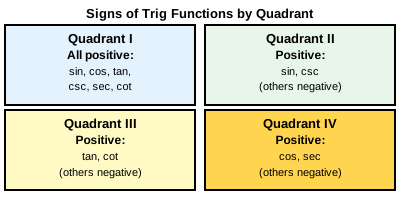
Given and is in Quadrant II,
which of the following is the value of ?
(Use the derived identity .)
Word Problems / Application
In physics, a unit vector at angle from the positive -axis
has components . The horizontal component
is given; find the vertical component using the Pythagorean identity.
An angle is in Quadrant IV. A physics student knows that the
horizontal component of a unit vector at angle is
.
What is the vertical component ?
(The vertical component is negative in QIV.)
Express your answer as a fraction in simplest form.
A surveyor uses a clinometer. The angle satisfies
and is in Quadrant I.
Find . Express your answer as a fraction in simplest form.
Using your answer from part (a), find .
Express your answer as a fraction in simplest form.
A student is checking the reasonableness of a calculated answer before
applying the Pythagorean identity. They need to know which sign pattern
is consistent with Quadrant III.
An angle is in Quadrant III. Which combination of signs is
possible for ?
Error Analysis
Problem: Given and in Quadrant IV,
find .
Student's work:
- ← (did not consider the quadrant)
Student's final answer:
A student solved the following problem and made an error.
Identify the mistake and select the correct final answer.
Problem: Given , a student
claims: "If I take the square root of both sides, I get
."
Student's reasoning:
, therefore
.
A student made an algebra error when working with the Pythagorean
identity. Identify the error and choose the correction.
Challenge / Extension
Given and in Quadrant III, find all six
trigonometric values and then state .
Use the derived identity .
In Quadrant III, and therefore .
Express in simplest radical form
(e.g., write -sqrt(5) for ).
Write a complete proof of
starting from the unit circle equation .
Your proof should:
- State what the unit circle is.
- Identify the coordinates of a general point on the unit circle.
- Substitute those coordinates into the circle equation.
- Explain why the result holds for every value of , not just
special angles.
Write 3–5 complete sentences.