Exercises: Informal Arguments for Volume and Area Formulas
Warm-Up
Which statement best describes an informal argument in mathematics?
A regular polygon is inscribed in a circle. As the number of sides of the polygon increases, what happens to its perimeter?
Which expression gives the area of a circle with radius ?
Fluency Practice
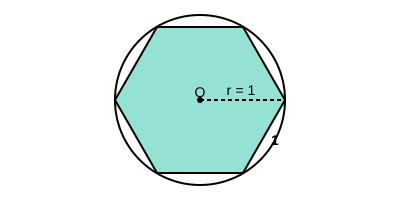
A regular hexagon is inscribed in a circle of radius 1. Each side of the hexagon equals the radius, so each side has length 1. What is the perimeter of the hexagon, and how does it compare to the circumference ?
In the wedge-dissection argument for circle area, a circle of radius is cut into many thin sectors and rearranged into a shape resembling a rectangle. Which dimensions does this near-rectangle have, and what area does it give?
A cylindrical pipe has radius cm and height cm. Using , compute the volume. Express your answer in terms of (e.g., write ).
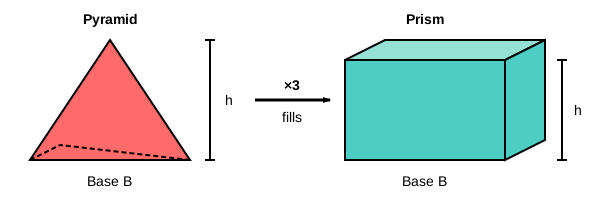
A square pyramid and a square prism share the same square base (area ) and the same height . A student fills the pyramid with sand three times and pours it into the prism. The prism is exactly full. What does this demonstrate about the pyramid's volume?
A square pyramid has a square base with side length 6 m and height m. Compute its volume using . The base area m². Express your answer in cubic meters.
A cone has radius cm and height cm. Compute its volume using . Express your answer in terms of .
Varied Practice
A cylinder is formed by stacking thin circular disks of radius , each with thickness . Each disk has area , so its volume is ̲ ̲ ̲ ̲ ̲ ̲ ̲ ̲ ̲ ̲ ̲ ̲ ̲ ̲ ̲ ̲ ̲ ̲ ̲ ̲ ̲ ̲ . Stacking enough disks to total height gives total volume ̲ ̲ ̲ ̲ ̲ ̲ ̲ ̲ ̲ ̲ ̲ ̲ ̲ ̲ ̲ ̲ ̲ ̲ ̲ ̲ ̲ ̲ .
A student inscribes regular polygons in a unit circle (radius = 1) and records each polygon's perimeter: 4 sides gives 5.657, 6 sides gives 6.000, 8 sides gives 6.123, 12 sides gives 6.212, and 24 sides gives 6.265. Which conclusion is best supported by this data?
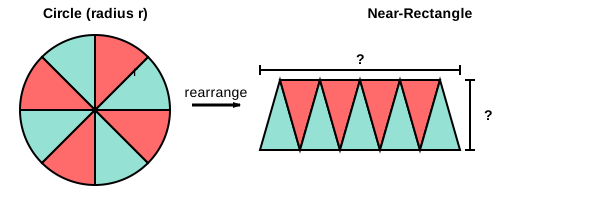
The wedge-dissection argument for rearranges circular sectors into a near-rectangle. Which property of the near-rectangle directly explains why appears in the area formula?
For a circle of radius : the circumference is ̲ ̲ ̲ ̲ ̲ ̲ ̲ ̲ ̲ ̲ ̲ ̲ ̲ ̲ ̲ ̲ ̲ ̲ ̲ ̲ ̲ ̲ and the area is ̲ ̲ ̲ ̲ ̲ ̲ ̲ ̲ ̲ ̲ ̲ ̲ ̲ ̲ ̲ ̲ ̲ ̲ ̲ ̲ ̲ ̲ . Circumference is measured in ̲ ̲ ̲ ̲ ̲ ̲ ̲ ̲ ̲ ̲ ̲ ̲ ̲ ̲ ̲ ̲ ̲ ̲ ̲ ̲ ̲ ̲ units, while area is measured in ̲ ̲ ̲ ̲ ̲ ̲ ̲ ̲ ̲ ̲ ̲ ̲ ̲ ̲ ̲ ̲ ̲ ̲ ̲ ̲ ̲ ̲ units.
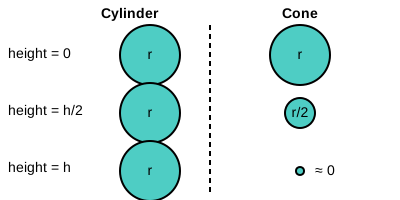
Cross-sections of a cylinder and a cone (both with radius and height ) are taken at three different heights. The diagram shows how each cross-section compares. Why does the cone have volume that of the cylinder?
A student says: 'Informal arguments are just guessing — only formal proofs count as real math.' Write 2–3 sentences responding to this claim. Use at least one specific example from this lesson.
Word Problems
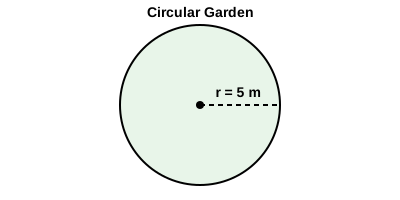
A circular garden has a radius of 5 meters. A gardener needs to install fencing around the edge and lay sod inside.
How much fencing (in meters) is needed to go around the entire garden? Express your answer in terms of .
How much area (in square meters) of sod is needed to cover the interior of the garden? Express your answer in terms of .
A manufacturer produces cylindrical cans with radius cm and height cm. Each can is filled completely with tomato soup.
What is the volume of soup in one can? Express your answer in terms of .
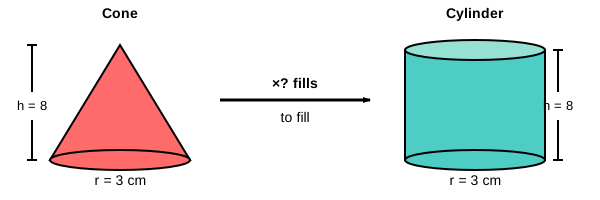
A cone-shaped paper cup and a cylindrical cup share the same circular base (radius cm) and the same height ( cm). Priya fills the cone with water and pours it into the cylinder, repeating until the cylinder is exactly full.
How many times must Priya fill the cone to exactly fill the cylinder? What does this tell you about the volumes of the cone and cylinder?
Compute the volume of the cone (in terms of ). Then verify that the cylinder's volume () is exactly 3 times the cone's volume.
Error Analysis
Marcus is computing volumes for a square pyramid with base area cm² and height cm. He writes:
"I used volume = base area times height, the same way I would for a prism."
What error did Marcus make, and what is the correct volume?
Destiny is finding the volume of a cone with radius cm and height cm. She writes:
"I used because volume is three-dimensional, so the radius must be cubed."
What mistake did Destiny make? Select the best description.
Challenge / Extension
The area-of-a-circle argument using concentric rings works as follows: imagine the circle as made of thin rings, each at radius (where ), with circumference and infinitesimal thickness. If you 'unroll' all rings and lay them flat, they form a right triangle. Describe the dimensions of this triangle and explain how its area gives .
A frustum is a cone with the top cut off. Suppose a cone of radius cm and height cm has a smaller cone of radius cm and height cm removed from the top.
Using , compute the frustum's volume in terms of .