Exercises: Informal Arguments for Sphere Volume Using Cavalieri's Principle
Recall / Warm-Up
A cylinder has radius cm and height cm. What is its volume?
A cone has radius cm and height cm. What is its volume?
A right triangle has legs and . Which expression gives the length of the hypotenuse?
Fluency Practice
Two solids each have height 8 cm. At every height between 0 and 8 cm, the cross-sectional area of Solid A equals the cross-sectional area of Solid B. By Cavalieri's principle, if Solid A has volume cm³, what is the volume of Solid B in cm³?
A hemisphere of radius cm is compared to a cylinder-minus-cone solid, where both the cylinder and the cone have radius 6 cm and height 6 cm. What is the volume of the cylinder-minus-cone solid in terms of ?
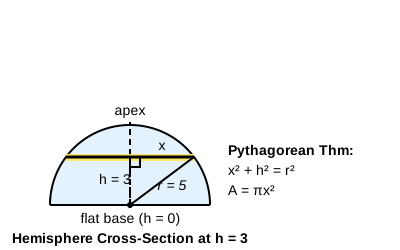
A hemisphere of radius cm is sliced horizontally at height cm above its flat base. Using the Pythagorean Theorem, find the cross-sectional area at that height. Express your answer in terms of .
For a hemisphere of radius , at height above the flat base, the cross-sectional radius satisfies ̲ ̲ ̲ ̲ ̲ ̲ ̲ ̲ ̲ ̲ ̲ ̲ ̲ ̲ ̲ ̲ ̲ ̲ ̲ ̲ ̲ ̲ . So the cross-sectional area is ̲ ̲ ̲ ̲ ̲ ̲ ̲ ̲ ̲ ̲ ̲ ̲ ̲ ̲ ̲ ̲ ̲ ̲ ̲ ̲ ̲ ̲ .
For the cylinder-minus-cone comparison solid (cylinder radius , height ; cone apex at base, base radius at top), at height the cone's inner radius equals ̲ ̲ ̲ ̲ ̲ ̲ ̲ ̲ ̲ ̲ ̲ ̲ ̲ ̲ ̲ ̲ ̲ ̲ ̲ ̲ ̲ ̲ . The annular cross-sectional area is ̲ ̲ ̲ ̲ ̲ ̲ ̲ ̲ ̲ ̲ ̲ ̲ ̲ ̲ ̲ ̲ ̲ ̲ ̲ ̲ ̲ ̲ .
Using the hemisphere argument: a hemisphere of radius has the same volume as a cylinder-minus-cone (both with radius and height ). Compute the hemisphere volume when cm. Express your answer in terms of .
Varied Practice
Cavalieri's principle says two solids have equal volumes if, at every height, their cross-sections have equal area. Which statement is correct?
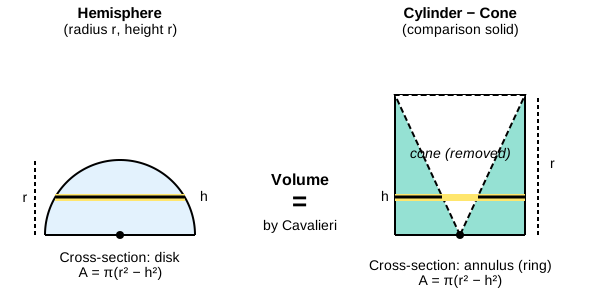
In the Cavalieri argument for sphere volume, a hemisphere of radius is compared to a cylinder-minus-cone composite solid.
Which description correctly identifies the cone's orientation in the comparison solid?
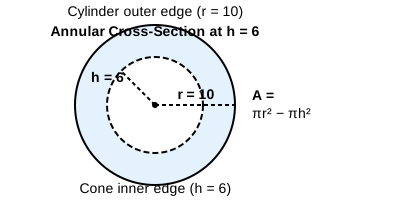
A hemisphere of radius cm and the cylinder-minus-cone comparison solid are sliced at height cm.
Complete: the hemisphere's cross-sectional area at is ̲ ̲ ̲ ̲ ̲ ̲ ̲ ̲ ̲ ̲ ̲ ̲ ̲ ̲ ̲ ̲ ̲ ̲ ̲ ̲ ̲ ̲ . The annulus area is ̲ ̲ ̲ ̲ ̲ ̲ ̲ ̲ ̲ ̲ ̲ ̲ ̲ ̲ ̲ ̲ ̲ ̲ ̲ ̲ ̲ ̲ . The two areas are ̲ ̲ ̲ ̲ ̲ ̲ ̲ ̲ ̲ ̲ ̲ ̲ ̲ ̲ ̲ ̲ ̲ ̲ ̲ ̲ ̲ ̲ .
An oblique cylinder is a cylinder whose axis is tilted rather than vertical. Cavalieri's principle implies that an oblique cylinder with radius and vertical height has the same volume as a right cylinder with radius and height . Why?
Word Problems
A spherical water tank at a summer camp has a radius of 9 m. Camp staff need to know how much water it can hold.
Using the sphere volume formula , find the exact volume of the tank in terms of .
Tomás is verifying the sphere volume formula by using the Cavalieri argument. He uses a hemisphere of radius cm compared to a cylinder (radius 6 cm, height 6 cm) with a cone (radius 6 cm, height 6 cm) removed from the interior.
Compute the volume of the cylinder in terms of .
Compute the volume of the cone in terms of .
By Cavalieri's principle, the hemisphere volume equals the cylinder volume minus the cone volume. Use this to find the full sphere volume in terms of .
Two stacks of books have the same height. Each book in the first stack is rectangular with a base of 100 cm². Each book at the same level in the second stack is circular with an area of 100 cm². Both stacks have 20 books.
By Cavalieri's principle, if the first stack has total volume 2000 cm³, what is the volume of the second stack?
Error Analysis
A student is computing the annular cross-sectional area of the cylinder-minus-cone comparison solid at height .
Student's work:
"The cylinder has outer radius , and the cone's cross-section at height has inner radius (since the cone gets smaller as you go up). So the annulus area is:
This is not equal to , so Cavalieri's principle cannot apply."
What error did the student make? Which choice correctly identifies the mistake and gives the right annulus area?
A student is deriving the sphere volume from the Cavalieri argument.
Student's work:
"By Cavalieri's principle, the hemisphere has the same volume as the cylinder minus the cone.
So the sphere volume is ."
What error did the student make?
Challenge
The sphere volume formula is . Trace the arithmetic of the Cavalieri derivation to explain, in your own words, where the fraction comes from. Your explanation should identify the two steps that produce this factor.
An oblique prism and a right rectangular prism both have a rectangular base of length 8 cm and width 5 cm, and both have vertical height 12 cm. The oblique prism's lateral faces are tilted at an angle.
By Cavalieri's principle, what is the volume of the oblique prism in cm³?