Exercises: Identify Cross-Sections and Solids of Revolution
Warm-Up
A cross-section is best described as:
A horizontal slice (parallel to the base) is taken through a cone. What shape is the cross-section?
A solid of revolution is created by:
Fluency Practice
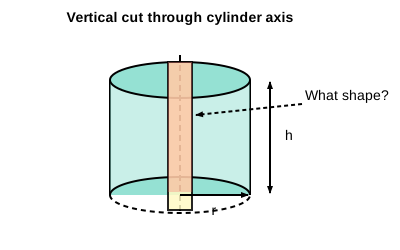
A vertical plane passes through the axis of a cylinder (a plane containing the cylinder's central axis). What shape is the cross-section?
A sphere of radius is sliced by a plane at a distance from the center, where . What shape is the cross-section, and how does its size compare to a cross-section through the center?
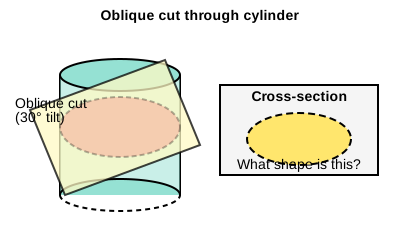
A cylinder is sliced by a plane that is tilted at an angle to the axis (oblique to the axis, not perpendicular and not parallel). What shape is the cross-section?
A right triangle is rotated about its vertical leg. Which solid is produced?
A rectangle with width 3 cm and height 8 cm is rotated about its longer edge (height = 8 cm). Which solid is produced, and what are its dimensions?
Varied Practice
For each solid, identify the cross-section shape produced by the described cut.
- A rectangular prism cut by a plane parallel to a rectangular face: ̲ ̲ ̲ ̲ ̲ ̲ ̲ ̲ ̲ ̲ ̲ ̲ ̲ ̲ ̲ ̲ ̲ ̲ ̲ ̲ ̲ ̲
- A square pyramid cut by a horizontal plane (parallel to the base, halfway up): ̲ ̲ ̲ ̲ ̲ ̲ ̲ ̲ ̲ ̲ ̲ ̲ ̲ ̲ ̲ ̲ ̲ ̲ ̲ ̲ ̲ ̲
- A sphere cut by any plane: ̲ ̲ ̲ ̲ ̲ ̲ ̲ ̲ ̲ ̲ ̲ ̲ ̲ ̲ ̲ ̲ ̲ ̲ ̲ ̲ ̲ ̲
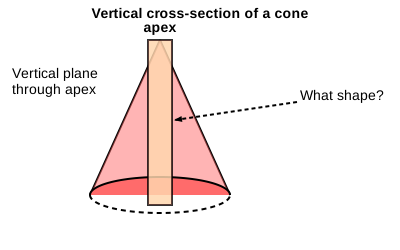
A cone is sliced by a vertical plane that passes through the apex (the tip) of the cone. What shape is the cross-section?
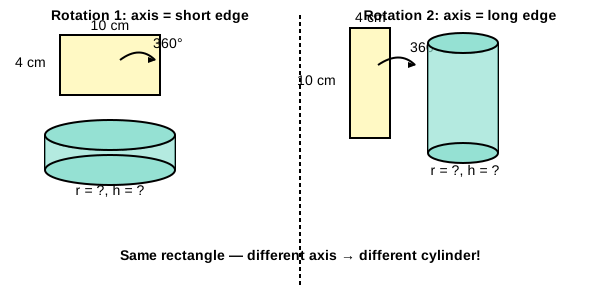
The same rectangle (width 4 cm, height 10 cm) is rotated about two different axes. Rotation 1: about the short edge (4 cm). Rotation 2: about the long edge (10 cm). Which statement correctly compares the two solids?
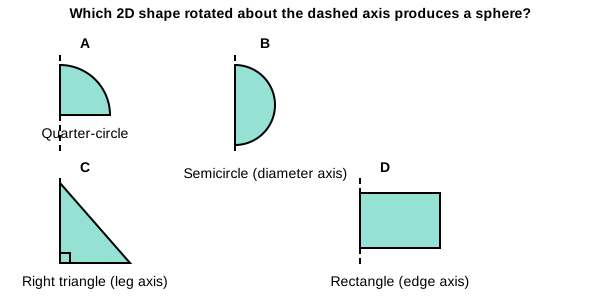
Which two-dimensional shape, when rotated about the dashed axis shown, produces a sphere?
Word Problems
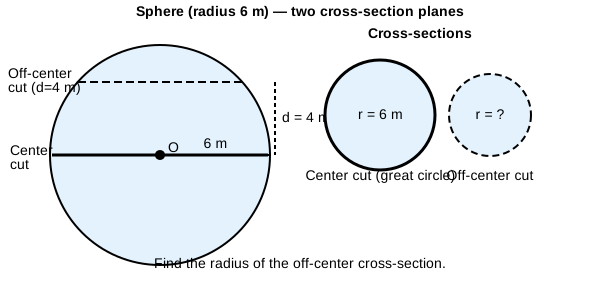
A water tower tank has the shape of a sphere with radius 6 meters. An engineer needs to analyze the cross-sections to design internal supports.
The engineer takes a horizontal cross-section through the center of the sphere. What is the radius of this cross-section circle?
The engineer also takes a horizontal cross-section at a height of 4 m above the center of the sphere. Using where m is the sphere's radius and m is the distance from the center, find the radius of this cross-section circle. Round to the nearest tenth.
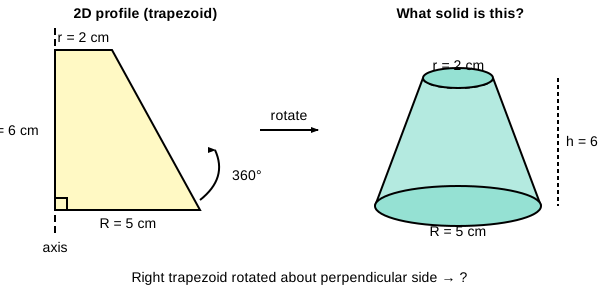
A manufacturing company uses a lathe to produce metal parts by spinning a 2D profile about an axis. The engineer designs each part by specifying the 2D profile and the axis of rotation.
The engineer rotates a right trapezoid (shown in the diagram) about its perpendicular side (the vertical leg). Which solid is produced?
The engineer wants to produce a part whose cross-section (taken perpendicular to the axis) at any height is always a circle. Is this guaranteed for every solid of revolution? Explain why or why not.
Error Analysis
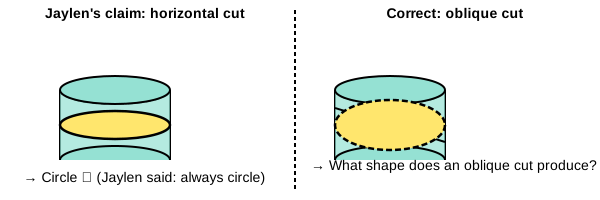
A teacher asks: "A cylinder is sliced by a plane that is not perpendicular to the axis and not parallel to the axis — it is tilted at 30° to the horizontal. What shape is the cross-section?"
Jaylen answers: "It's a circle. Cylinders always have circular cross-sections because the cylinder itself is circular."
What is wrong with Jaylen's reasoning? Select the best correction.
A student is asked: "What solid is produced when a rectangle is rotated about one of its edges?"
The student writes: "You always get the same cylinder no matter which edge you rotate around — the shape is a rectangle either way, so the solid is always the same cylinder."
Which statement best identifies and corrects the student's error?
Challenge / Extension
A cube has side length . A plane is passed through the midpoints of six edges — two edges on each of three pairs of opposite faces — so that it cuts through all six faces of the cube. What shape is the cross-section? Explain your reasoning, including why the cross-section cannot be a rectangle or triangle.
A solid of revolution is formed by rotating a right trapezoid about its perpendicular side. The trapezoid has: perpendicular side (axis) of length 6 cm, bottom horizontal edge of length 5 cm, and top horizontal edge of length 2 cm. The resulting solid is a frustum (truncated cone). Using where cm, cm, and cm, compute the volume in terms of .