Back to Explain sine and cosine relationship

Exercises: Sine and Cosine of Complementary Angles

Grade 9·20 problems·~28 min·Common Core Math - HS Geometry·standard·hsg-srt-c-7
Work through problems with immediate feedback
A

Warm-Up

1.

Two angles are complementary. One angle measures 35°. What is the measure of the other angle?

2.

In a right triangle with acute angles α\alpha and β\beta, which statement must be true?

3.

In a right triangle with legs of length 3 and 4 and hypotenuse of length 5, if θ\theta is the angle opposite the side of length 3, then sin(θ)=oppositehypotenuse=000000000000\sin(\theta) = \dfrac{\text{opposite}}{\text{hypotenuse}} = \dfrac{\hspace{0.2em}\fbox{\phantom{000000}}\hspace{0.2em}}{\hspace{0.2em}\fbox{\phantom{000000}}\hspace{0.2em}} and cos(θ)=adjacenthypotenuse=000000000000\cos(\theta) = \dfrac{\text{adjacent}}{\text{hypotenuse}} = \dfrac{\hspace{0.2em}\fbox{\phantom{000000}}\hspace{0.2em}}{\hspace{0.2em}\fbox{\phantom{000000}}\hspace{0.2em}}.

opposite side:
hypotenuse for sin:
adjacent side:
hypotenuse for cos:
B

Fluency Practice

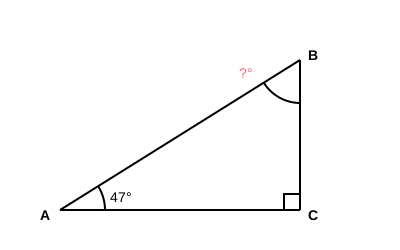
Right triangle ABC with right angle at C, angle A labeled 47 degrees, and angle B unknown
1.

In right triangle ABCABC with right angle at CC, if A=47°\angle A = 47\degree, then B=°\angle B = \underline{\hspace{5em}}\degree. The two acute angles are   ̲ ̲ ̲ ̲ ̲ ̲ ̲ ̲ ̲ ̲ ̲ ̲ ̲ ̲ ̲ ̲ ̲ ̲ ̲ ̲ ̲ ̲   angles.

measure of angle B:
relationship type:
2.

Which equation correctly states the complementary angle relationship for sine and cosine?

3.

Given that sin(32°)0.53\sin(32\degree) \approx 0.53, use the complementary angle relationship to find cos(58°)\cos(58\degree) without a calculator. cos(58°)=sin(°)\cos(58\degree) = \sin(\underline{\hspace{5em}}\degree) \approx \underline{\hspace{5em}}.

complementary angle:
value:
4.

Given that cos(71°)0.326\cos(71\degree) \approx 0.326, find sin(19°)\sin(19\degree) without a calculator. sin(19°)=cos(°)\sin(19\degree) = \cos(\underline{\hspace{5em}}\degree) \approx \underline{\hspace{5em}}.

complementary angle:
value:
5.

Simplify cos(90°x)\cos(90\degree - x). Your answer should be a single trig function of xx: cos(90°x)=\cos(90\degree - x) = \underline{\hspace{5em}}.

simplified expression:
C

Varied Practice

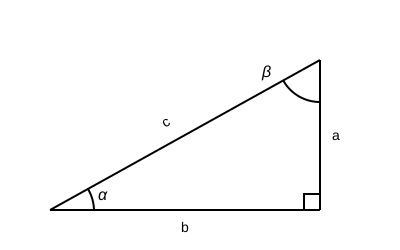
Right triangle with acute angles alpha at bottom-left and beta at top-right, with sides labeled a, b, and c (hypotenuse)
1.

The diagram shows a right triangle with both acute angles labeled. Which statement about sin(α)\sin(\alpha) and cos(β)\cos(\beta) is true?

2.

Solve the equation sin(θ)=cos(40°)\sin(\theta) = \cos(40\degree) for θ\theta where 0°<θ<90°0\degree < \theta < 90\degree. First, rewrite cos(40°)\cos(40\degree) using the complementary relationship: cos(40°)=sin(°)\cos(40\degree) = \sin(\underline{\hspace{5em}}\degree). Then θ=°\theta = \underline{\hspace{5em}}\degree.

equivalent sine angle:
value of theta:
3.

Nadia writes: 'sin(90°θ)=sin(90°)sin(θ)=1sin(θ)\sin(90\degree - \theta) = \sin(90\degree) - \sin(\theta) = 1 - \sin(\theta).' What error did Nadia make?

4.

Using a right triangle diagram and the definitions of sine and cosine, explain in 2–3 sentences why sin(θ)=cos(90°θ)\sin(\theta) = \cos(90\degree - \theta) for any acute angle θ\theta.

D

Word Problems

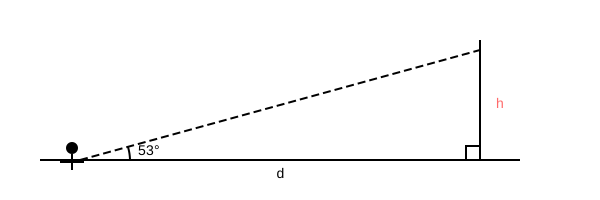
Surveyor on the left at ground level looking up at a 53-degree angle of elevation to the top of a vertical cliff on the right
1.

A surveyor stands at a point on flat ground and measures the angle of elevation to the top of a cliff. The angle of elevation from the surveyor to the cliff top is 53°.

1.

What is the angle between the cliff's vertical face and the line of sight from the surveyor to the cliff top? The angle at the cliff top is   ̲ ̲ ̲ ̲ ̲ ̲ ̲ ̲ ̲ ̲ ̲ ̲ ̲ ̲ ̲ ̲ ̲ ̲ ̲ ̲ ̲ ̲   °.

angle at cliff top:
2.

A classmate says: 'I can find sin(53°)\sin(53\degree) without a calculator if I know cos(37°)\cos(37\degree).' Complete their reasoning: sin(53°)=cos(°)\sin(53\degree) = \cos(\underline{\hspace{5em}}\degree) because   ̲ ̲ ̲ ̲ ̲ ̲ ̲ ̲ ̲ ̲ ̲ ̲ ̲ ̲ ̲ ̲ ̲ ̲ ̲ ̲ ̲ ̲   and   ̲ ̲ ̲ ̲ ̲ ̲ ̲ ̲ ̲ ̲ ̲ ̲ ̲ ̲ ̲ ̲ ̲ ̲ ̲ ̲ ̲ ̲   are complementary angles.
complementary angle:
first angle:
second angle:
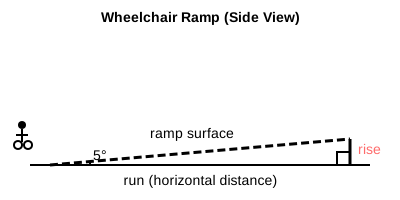
Side view of a wheelchair ramp showing a right triangle with a 5-degree angle between the ramp and the ground
2.

Priya is designing a wheelchair ramp. Building codes require that the angle between the ramp surface and the ground is no more than 5°. Priya knows that cos(85°)0.087\cos(85\degree) \approx 0.087.

Using the complementary angle relationship, find sin(5°)\sin(5\degree) without a calculator. Enter your answer as a decimal rounded to three decimal places.

3.

Marcus knows that sin(62°)0.883\sin(62\degree) \approx 0.883 and cos(62°)0.469\cos(62\degree) \approx 0.469. He needs to evaluate the expression sin(62°)+cos(28°)\sin(62\degree) + \cos(28\degree) for a physics problem.

Find the value of sin(62°)+cos(28°)\sin(62\degree) + \cos(28\degree) without a calculator. (Hint: look for complementary angles before reaching for your calculator.)

E

Error Analysis

1.

Javier is working on this problem: "If sin(30°)=0.5\sin(30\degree) = 0.5, find cos(30°)\cos(30\degree) using the complementary relationship."
Javier writes:
cos(30°)=sin(90°30°)=sin(60°)0.866\cos(30\degree) = \sin(90\degree - 30\degree) = \sin(60\degree) \approx 0.866
But then Javier says: "Wait — the complement of 30° is 30° itself, because complementary angles are equal. So cos(30°)=sin(30°)=0.5\cos(30\degree) = \sin(30\degree) = 0.5."

Which part of Javier's work is correct, and what is his error?

2.

Leila is solving: "Find sin(105°)\sin(105\degree) using the complementary relationship."
Leila writes:
sin(105°)=cos(90°105°)=cos(15°)\sin(105\degree) = \cos(90\degree - 105\degree) = \cos(-15\degree)
Leila concludes: "So sin(105°)=cos(15°)\sin(105\degree) = \cos(-15\degree). I'll use the complementary relationship for any angle."

What is the fundamental error in Leila's approach?

F

Challenge / Extension

1.

Simplify the expression sin(20°)+cos(70°)+sin(70°)+cos(20°)\sin(20\degree) + \cos(70\degree) + \sin(70\degree) + \cos(20\degree) without a calculator. Show your steps and explain which relationship you used.

2.

Write a formal proof of the statement: 'In any right triangle, the sine of each acute angle equals the cosine of the other acute angle.' Your proof should: (1) start by labeling the triangle and its sides, (2) use the definitions of sine and cosine, and (3) end with a clear conclusion. Use at least 4 numbered steps.

0 of 20 answered