Exercises: Solve Right Triangles in Applied Problems
Recall / Warm-Up
A right triangle has one acute angle of 32° and a right angle. What is the measure of the other acute angle?
Which equation correctly applies SOH-CAH-TOA to find the side labeled in a right triangle where the acute angle is , the hypotenuse is 10, and is the side opposite ?
A right triangle has legs of length 5 and 12. What is the length of the hypotenuse? Round to the nearest tenth if needed.
Fluency Practice
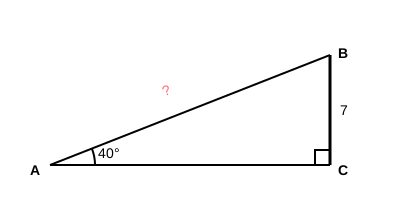
In the right triangle shown, the acute angle at is 40° and the side opposite has length 7. Find the length of the hypotenuse. Round to the nearest hundredth.
A right triangle has a hypotenuse of 15 and one acute angle of 60°. Find the length of the side adjacent to the 60° angle. Round to the nearest tenth.
In a right triangle, the side opposite the acute angle has length 9 and the side adjacent to has length 12. Find in degrees. Round to the nearest tenth.
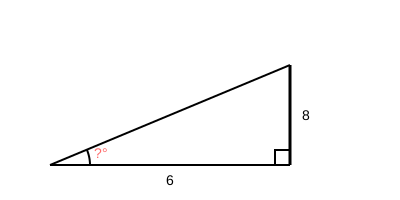
A right triangle has legs of length 6 (horizontal) and 8 (vertical). Find the acute angle at the bottom-left vertex, between the hypotenuse and the horizontal leg. Round to the nearest tenth of a degree.
A right triangle has a hypotenuse of 10 and one acute angle of 35°. Which pair of expressions correctly gives the two legs? (Use and .)
Varied Practice
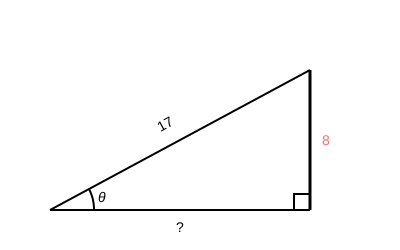
The diagram shows a right triangle with hypotenuse 17 and one acute angle . The side opposite has length 8. Find in degrees. Round to the nearest tenth.
To fully solve the right triangle with hypotenuse 20 and acute angle 50°, complete the following: The side opposite 50° is ̲ ̲ ̲ ̲ ̲ ̲ ̲ ̲ ̲ ̲ ̲ ̲ ̲ ̲ ̲ ̲ ̲ ̲ ̲ ̲ ̲ ̲ (to the nearest tenth). The side adjacent to 50° is ̲ ̲ ̲ ̲ ̲ ̲ ̲ ̲ ̲ ̲ ̲ ̲ ̲ ̲ ̲ ̲ ̲ ̲ ̲ ̲ ̲ ̲ (to the nearest tenth). The other acute angle is ̲ ̲ ̲ ̲ ̲ ̲ ̲ ̲ ̲ ̲ ̲ ̲ ̲ ̲ ̲ ̲ ̲ ̲ ̲ ̲ ̲ ̲ °. Use and .
A right triangle has two sides known: a leg of length 5 and the hypotenuse of length 13. Which is the most direct way to find the remaining leg?
In a right triangle, you know two sides and need to find one of the acute angles. Which tool should you use?
Word Problems
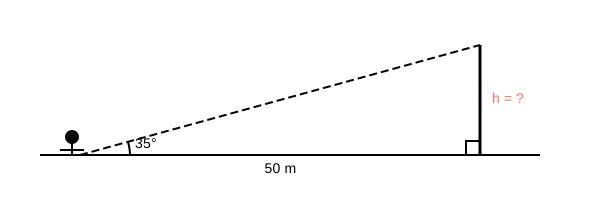
A person stands 50 m from the base of a building on flat ground and measures the angle of elevation to the top of the building as 35°. Use and .
Find the height of the building. Round to the nearest tenth of a metre.
Find the straight-line distance from the person to the top of the building (the line of sight). Round to the nearest tenth of a metre. Use .
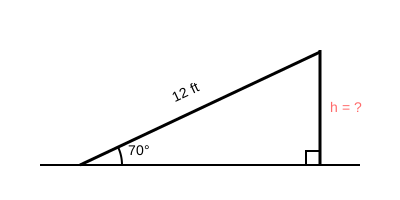
A 12 ft ladder leans against a vertical wall. The base of the ladder makes an angle of 70° with the flat ground.
How high up the wall does the ladder reach? Round to the nearest tenth of a foot. Use .
A ship leaves port and sails 8 km due north, then turns and sails 6 km due east.
What is the straight-line distance from the port to the ship's final position? Round to the nearest tenth of a kilometre.
Error Analysis
Maya is solving this problem: "In a right triangle, the side opposite the angle is 5 and the side adjacent to is 12. Find ."
Maya writes: , so .
What mistake did Maya make?
Carlos is solving this problem: "From the top of a 40 m cliff, the angle of depression to a boat is 30°. Find the horizontal distance from the cliff base to the boat."
Carlos draws the angle of 30° at the base of the cliff (at the water level), not at the top of the cliff. He then writes: , giving m.
What error did Carlos make in his diagram, and what is the correct equation?
Challenge / Extension
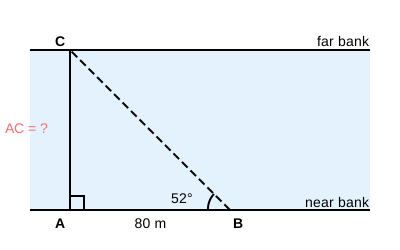
A surveyor needs to find the width of a river. She stands at point on one bank and marks point directly across the river (so is perpendicular to the bank, making a right angle at ). She then walks 80 m along the bank to point and sights point at an angle of 52° from the bank direction (angle ). Find the width of the river (). Round to the nearest tenth of a metre. Use .
A ship navigator uses bearings. The navigator says: 'We sailed on bearing N40°E for 100 km.' A crew member interprets this as: 'We sailed 40° from east toward north.' Explain the correct interpretation of N40°E, draw a simple sketch showing the correct direction, and find the northward and eastward components of the 100 km journey. Use and .