Back to Prove Laws of Sines and Cosines

Exercises: Prove the Laws of Sines and Cosines

Grade 10·21 problems·~35 min·Common Core Math - HS Geometry·standard·hsg-srt-d-10
Work through problems with immediate feedback
A

Recall and Warm-Up

1.

Which equation correctly states the Law of Sines for triangle ABCABC with sides aa, bb, cc opposite angles AA, BB, CC?

2.

In triangle ABCABC, an altitude hh is drawn from vertex CC to side ABAB. In the resulting right triangle, sin(A)=hb\sin(A) = \dfrac{h}{b}. What does this give for hh?

3.

Which of the following is the Pythagorean identity used in the Law of Cosines proof?

B

Fluency Practice

1.

In triangle ABCABC, angle A=30°A = 30\degree, angle B=50°B = 50\degree, and side a=10a = 10. Use sin(30°)=0.5\sin(30\degree) = 0.5 and sin(50°)0.766\sin(50\degree) \approx 0.766. Find side bb. Round to the nearest tenth.

2.

Complete the key step in the Law of Sines proof. In triangle ABCABC, altitude hh from CC gives h=bsinAh = b \sin A and h=asinBh = a \sin B. Setting them equal: bsinA=asinBb \sin A = a \sin B. After dividing both sides by sinAsinB\sin A \cdot \sin B, the result is:   ̲ ̲ ̲ ̲ ̲ ̲ ̲ ̲ ̲ ̲ ̲ ̲ ̲ ̲ ̲ ̲ ̲ ̲ ̲ ̲ ̲ ̲   =   ̲ ̲ ̲ ̲ ̲ ̲ ̲ ̲ ̲ ̲ ̲ ̲ ̲ ̲ ̲ ̲ ̲ ̲ ̲ ̲ ̲ ̲  
left side:
right side:
3.

In triangle ABCABC, sides a=7a = 7, b=10b = 10, and included angle C=60°C = 60\degree. Use cos(60°)=0.5\cos(60\degree) = 0.5. Find side cc. Round to the nearest tenth.

4.

Complete the final step in the Law of Cosines proof. After expanding the distance formula and regrouping, we have: c2=a2(cos2C+sin2C)+b22abcosCc^2 = a^2(\cos^2 C + \sin^2 C) + b^2 - 2ab\cos C. Applying the Pythagorean identity sin2C+cos2C=1\sin^2 C + \cos^2 C = 1 gives: c2=c^2 =   ̲ ̲ ̲ ̲ ̲ ̲ ̲ ̲ ̲ ̲ ̲ ̲ ̲ ̲ ̲ ̲ ̲ ̲ ̲ ̲ ̲ ̲  

final formula:
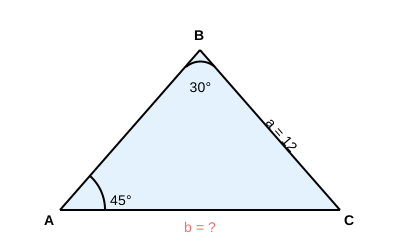
Triangle ABC with angle A = 45 degrees, angle B = 30 degrees, and side a = 12, with side b to be found
5.

Triangle ABCABC has angle A=45°A = 45\degree, angle B=30°B = 30\degree, and side a=12a = 12. Use sin(45°)0.707\sin(45\degree) \approx 0.707 and sin(30°)=0.5\sin(30\degree) = 0.5. Find side bb. Round to the nearest tenth.

C

Varied Practice

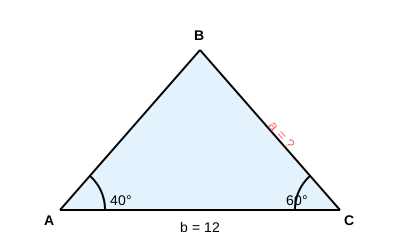
Triangle ABC with angle A = 40 degrees, angle C = 60 degrees, and base b = 12, with side a to be found
1.

In triangle ABCABC, angle A=40°A = 40\degree, angle C=60°C = 60\degree, and side b=12b = 12. Use sin(40°)0.643\sin(40\degree) \approx 0.643, sin(60°)0.866\sin(60\degree) \approx 0.866, and sin(80°)0.985\sin(80\degree) \approx 0.985. Find side aa. Round to the nearest tenth.

2.

In triangle ABCABC with C=90°C = 90\degree, the Law of Cosines gives c2=a2+b22abcosCc^2 = a^2 + b^2 - 2ab\cos C. What is cos(90°)\cos(90\degree), and what does the formula reduce to?

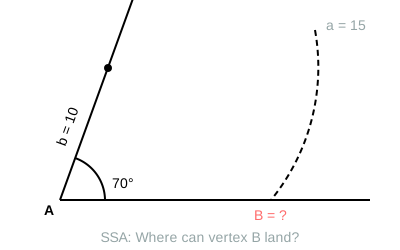
SSA setup showing angle A = 70 degrees, side b = 10 along one ray, and a circular arc of radius a = 15 indicating where vertex B could be on the base ray
3.

In triangle ABCABC, A=70°A = 70\degree, a=15a = 15, and b=10b = 10. A student computes sinB=bsinAa=10×0.940150.627\sin B = \dfrac{b \sin A}{a} = \dfrac{10 \times 0.940}{15} \approx 0.627. How many valid triangles exist with these measurements?

4.

In triangle ABCABC, sides a=8a = 8 and b=11b = 11 with included angle C=50°C = 50\degree. Use cos(50°)0.643\cos(50\degree) \approx 0.643. Find side cc. Round to the nearest tenth.

5.

A triangle has all three sides known: a=5a = 5, b=7b = 7, c=9c = 9. Which law and case applies, and what is the correct first step?

D

Word Problems

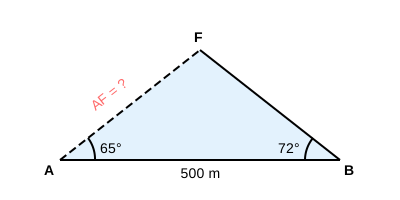
Top-down diagram of two observation posts A and B, 500 m apart, with angle 65 degrees at A and angle 72 degrees at B toward a wildfire at F, with distance AF to be found
1.

Two rangers at observation posts AA and BB, which are 500 m apart, spot a wildfire at point FF. Ranger AA measures angle FAB=65°\angle FAB = 65\degree and Ranger BB measures angle FBA=72°\angle FBA = 72\degree.

Find the distance from post AA to the fire. Use sin(43°)0.682\sin(43\degree) \approx 0.682 and sin(72°)0.951\sin(72\degree) \approx 0.951. Round to the nearest whole metre.

2.

In triangle ABCABC, angle A=40°A = 40\degree, side a=10a = 10 (opposite AA), and side b=12b = 12. Using the Law of Sines: sinB=bsinAa=12×0.643100.771\sin B = \dfrac{b \sin A}{a} = \dfrac{12 \times 0.643}{10} \approx 0.771. Use sin1(0.771)50.5°\sin^{-1}(0.771) \approx 50.5\degree.

1.

How many valid triangles exist with these measurements?

2.

Both values of angle BB are B150.5°B_1 \approx 50.5\degree and B2=180°50.5°B_2 = 180\degree - 50.5\degree. Give the larger value of angle BB.

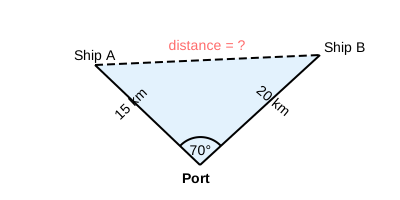
SAS triangle diagram showing two ships leaving port, one traveling 15 km and the other 20 km with a 70 degree angle between their courses
3.

Two ships leave port at the same time. Ship A travels 15 km and Ship B travels 20 km. The angle between their courses is 70°.

Find the distance between the two ships. Use cos(70°)0.342\cos(70\degree) \approx 0.342. Round to the nearest tenth.

E

Error Analysis

1.

Priya is given triangle ABCABC with a=8a = 8, b=11b = 11, and C=50°C = 50\degree (the angle between sides aa and bb). She writes:
8sinA=11sinB=csin50°\frac{8}{\sin A} = \frac{11}{\sin B} = \frac{c}{\sin 50\degree}
She then tries to solve for cc using the Law of Sines.

What error did Priya make, and what should she have done instead?

2.

Marcus is solving for side cc in triangle ABCABC with a=7a = 7, b=10b = 10, C=60°C = 60\degree. He writes:
c2=72+102+2(7)(10)cos60°=49+100+70=219c^2 = 7^2 + 10^2 + 2(7)(10)\cos 60\degree = 49 + 100 + 70 = 219
c=21914.8c = \sqrt{219} \approx 14.8

What error did Marcus make?

F

Challenge

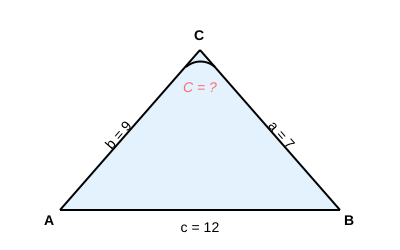
Triangle ABC with all three sides labeled: side a = 7, side b = 9, and base c = 12, with the largest angle C at the top vertex to be found
1.

In triangle ABCABC, all three sides are known: a=7a = 7, b=9b = 9, c=12c = 12. Use the Law of Cosines to find the largest angle CC (opposite the longest side cc). Use cos1(0.111)96.4°\cos^{-1}(-0.111) \approx 96.4\degree. Round to the nearest tenth of a degree.

2.

The Law of Cosines states c2=a2+b22abcosCc^2 = a^2 + b^2 - 2ab\cos C. Explain, in your own words, why this formula reduces to the Pythagorean Theorem when C=90°C = 90\degree. Then describe what happens to c2c^2 compared to a2+b2a^2 + b^2 when CC is acute versus when CC is obtuse. Use the sign of cosC\cos C in your explanation.

0 of 21 answered