Exercises: Apply the Law of Sines and the Law of Cosines
Recall / Warm-Up
Which formula correctly states the Law of Sines for triangle ?
A triangle has two sides and the included angle known (SAS). Which law should you use first to find the missing side?
A bearing of 150° points in which direction relative to north?
Fluency Practice
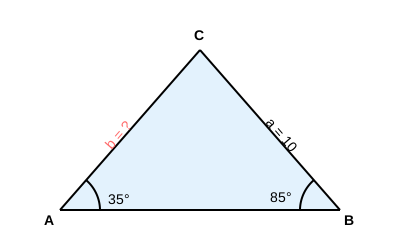
In triangle , angle , angle , and side . Use and . Find side . Round to the nearest tenth.
In triangle , angle , angle , and side . Use and . Find side . Round to the nearest tenth.
In triangle , angle , side , and side . Compute . How many valid triangles exist with these measurements?
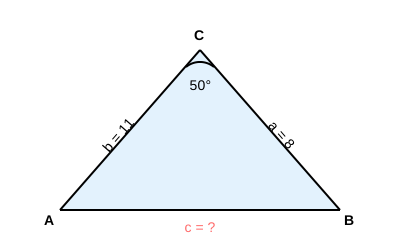
In triangle , side , side , and angle . Use . Find side . Round to the nearest tenth.
In triangle , all three sides are known: , , . Use the Law of Cosines to find angle (the largest angle, opposite side ). Use . Round to the nearest tenth of a degree.
Varied Practice
In triangle , angle , angle , and side (opposite angle ). Use and . Find side . Round to the nearest tenth.
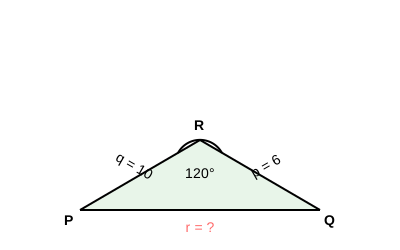
In triangle , side , side , and angle . Use . Find side . Round to the nearest whole number.
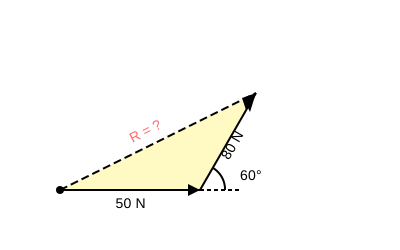
Two forces act on an object. Force 1 is 50 N directed east (0°). Force 2 is 80 N directed at 60° north of east. The angle between the two force vectors is 60°.
Find the magnitude of the resultant force . Use . Round to the nearest whole number.
Find the angle that the resultant makes with Force 1 (east). Use . Round to the nearest tenth.
In triangle , side , side , and angle . Use . Find side . Round to the nearest tenth.
In triangle , angle , side (opposite ), and side (adjacent to ). A student finds , gets , and concludes there is exactly one triangle. What should the student check next?
Word Problems
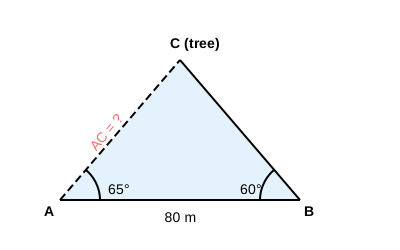
A surveyor wants to find the width of a canyon. From point on one side, she measures the angle to a tree at point on the opposite side as 65°. She then walks 80 m along the canyon edge to point and measures the angle to the same tree as 60°.
Find the distance from point to the tree at . Use and . Round to the nearest metre.
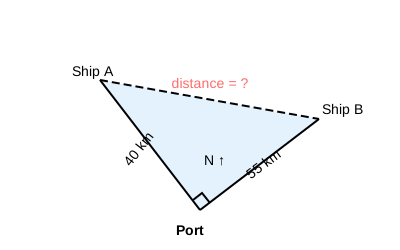
Two ships leave the same port at the same time. Ship A sails 40 km on a bearing of 030°. Ship B sails 55 km on a bearing of 120°.
Find the distance between the two ships. Use the fact that the angle between their paths is 90°. Round to the nearest tenth of a kilometre.
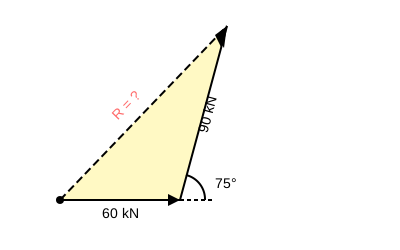
Two tugboats pull a disabled ship. Tugboat 1 exerts a force of 60 kN in one direction. Tugboat 2 exerts a force of 90 kN at an angle of 75° to Tugboat 1. Use and .
Find the magnitude of the resultant force. Round to the nearest whole number in kN.
Find the angle that the resultant makes with Tugboat 1's direction. Use . Round to the nearest tenth.
Error Analysis
Marcus solves a surveying problem: "Two observers at points and , which are 100 m apart, both sight the same tree at point . Observer measures angle ; observer measures angle ."
Without a diagram, Marcus writes: "I have two sides and a non-included angle (SSA), so I use the Law of Sines with sides and and angle ."
He then solves for using the SSA formula and gets m.
What is the fundamental error in Marcus's reasoning?
Priya is finding an unknown angle using SSA: triangle with , , .
She computes , finds , and stops, writing: "There is exactly one solution: ."
What is wrong with Priya's conclusion?
Challenge / Extension
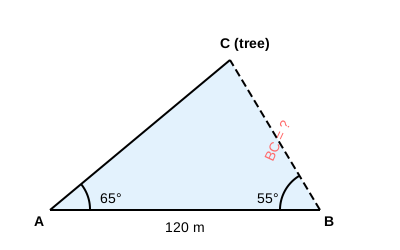
A surveyor at point wants to find the distance to a tree at point across a canyon. She measures a baseline m along the canyon edge. From , she measures the angle to as . From , she measures the angle to as . Find the distance . Use and . Round to the nearest metre.
A student uses the Law of Cosines to find a missing side in a triangle and gets . Describe two things the student should do: (1) explain why this answer is impossible in the context of a triangle, and (2) identify at least one type of error that could have produced this result.