Exercises: Derive the Formula A = (1/2)ab sin(C)
Recall / Warm-Up
A triangle has a base of 8 cm and a perpendicular height of 5 cm. What is its area?
In a right triangle, an acute angle is . The side opposite has length and the hypotenuse has length . Which equation is correct?
An altitude of a triangle is a line segment drawn from a vertex that is ̲ ̲ ̲ ̲ ̲ ̲ ̲ ̲ ̲ ̲ ̲ ̲ ̲ ̲ ̲ ̲ ̲ ̲ ̲ ̲ ̲ ̲ .
Fluency Practice
In the derivation of , an altitude is drawn from vertex perpendicular to side (= ). In the right triangle formed at vertex , the sine definition gives . Solving for : ̲ ̲ ̲ ̲ ̲ ̲ ̲ ̲ ̲ ̲ ̲ ̲ ̲ ̲ ̲ ̲ ̲ ̲ ̲ ̲ ̲ ̲ . Substituting into gives ̲ ̲ ̲ ̲ ̲ ̲ ̲ ̲ ̲ ̲ ̲ ̲ ̲ ̲ ̲ ̲ ̲ ̲ ̲ ̲ ̲ ̲ .
Find the area of a triangle with sides cm and cm and included angle . Use . Round to the nearest tenth.
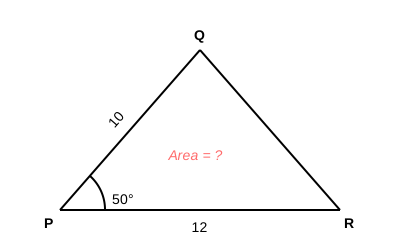
Triangle has sides and , with included angle . Find the area of triangle . Use . Round to the nearest tenth.
A triangle has sides m and m with included angle . Find its area. Use . Round to the nearest tenth.
Find the area of a triangle with two sides of length 4 ft and 9 ft and an included angle of 45°. Use . Round to the nearest tenth.
Varied Practice
Triangle has sides , , opposite angles , , respectively. Which of the following is a valid form of the area formula?
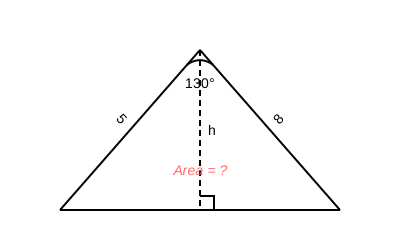
The triangle shown has two sides of 5 and 8 with an obtuse included angle of 130°. Find the area. Use . Round to the nearest tenth.
For a triangle with fixed sides and , which included angle produces the greatest area?
A triangle has a known base of 14 cm and a perpendicular height of 9 cm. Which formula should you use to find the area most directly?
Two triangles each have sides of length and . Triangle 1 has included angle . Triangle 2 has included angle . Compute the area of Triangle 1. Use . Round to the nearest tenth.
Word Problems
A triangular garden has two sides of 12 m and 15 m with an included angle of 70°.
Find the area of the garden. Use . Round to the nearest tenth of a square metre.
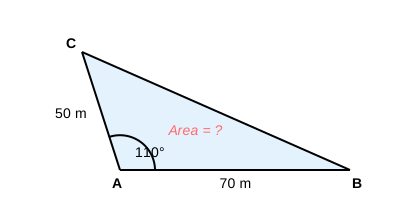
A surveyor measures a triangular land plot and records two boundary sides as 50 m and 70 m with an included angle of 110° between them.
Find the area of the land plot. Use . Round to the nearest whole square metre.
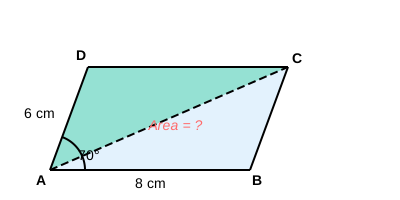
A parallelogram has adjacent sides of 8 cm and 6 cm with an included angle of 70°. A diagonal divides it into two congruent triangles.
Find the area of one triangle formed by the diagonal. Use . Round to the nearest tenth.
Find the total area of the parallelogram. Round to the nearest tenth.
Error Analysis
Triangle has , , and angle . Priya computes:
What error, if any, did Priya make?
Jamal computes the area of a triangle with sides 5 and 8 and included angle 30°:
What mistake did Jamal make?
Challenge / Extension
A triangular solar panel has two sides of 25 m and 30 m with an included angle of 55°. Find the area of the panel. Use . Round to the nearest tenth of a square metre.
Triangle 1 has sides and with included angle . Triangle 2 has the same sides and with included angle . Without computing, explain why the two triangles have the same area. What property of sine makes this happen? What does this tell you about how the area formula behaves near ?